
WeChat is a communication platform, social network, content system, service gateway and—where available—payment interface combined inside one application. In China, it often replaces a collection of separate apps: messaging, business communication, social updates, merchant discovery, transport access, bookings, customer service and QR payments can all begin inside WeChat. That breadth is why describing it as “China’s WhatsApp” is convenient but incomplete.
What is WeChat?
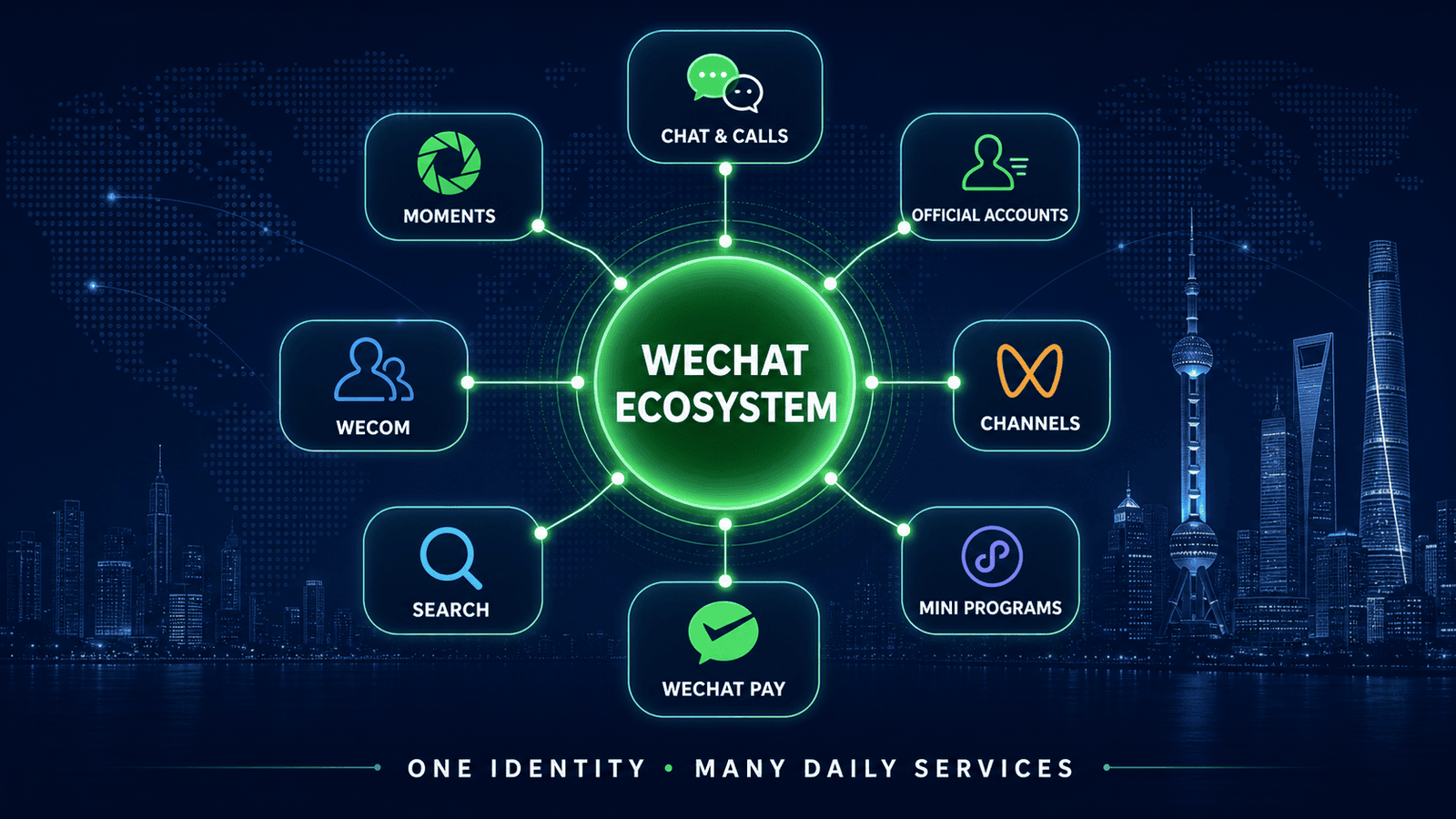
WeChat is a mobile and desktop platform developed by Tencent. Its foundation is private communication: one-to-one messages, group chats, voice notes, voice calls and video calls. Around that foundation sits a much wider network of functions. Users can publish updates in Moments, follow publishers through Official Accounts, watch short-form video through Channels, search for information, open lightweight applications called Mini Programs and—if eligible—make payments through WeChat Pay.
The word super-app is frequently used because the platform does not merely place unrelated shortcuts in one menu. Its components interact. A restaurant can publish an article through an Official Account, answer a question in chat, provide a booking Mini Program, collect a payment and issue an update—all without requiring the customer to move through several independent apps. A product recommendation can travel from a Channel video into a group chat and then into a Mini Program checkout. Identity, communication and service discovery are joined together.
This integration changes how people use the platform. In many Western apps, a conversation is the final product. In WeChat, a conversation can also be the doorway to a commercial or administrative process. A supplier may send specifications in chat, share a location pin, issue an invoice image and confirm receipt of payment in the same thread. A visitor might receive a hotel address, launch a map or transport service through a Mini Program, and communicate with the hotel without exchanging email.
WeChat and Weixin: related, interoperable, but not identical
Tencent describes Weixin and WeChat as separate but interoperable sister services. Weixin is designed for users in mainland China, while WeChat is designed for users elsewhere. The English word “WeChat” is often used loosely to refer to the entire product family, particularly in international conversation, but the legal and operational distinction matters.
An account’s service environment can depend on factors such as the mobile number used at registration, the account’s region, the version distributed through the relevant app store and subsequent account migration choices. Terms, privacy disclosures, available services and data-handling arrangements may differ. Users should therefore read the notices presented inside their own version of the app instead of assuming that a guide written for a mainland account applies word for word to an overseas account.
| Point | Weixin | |
|---|---|---|
| Primary audience | Users associated with mainland China | Users outside mainland China |
| Relationship | Separate but interoperable sister services within Tencent’s ecosystem | |
| Typical language context | Chinese-first domestic environment | International and multilingual environment |
| Feature availability | Deep access to China’s domestic service ecosystem | Varies by region, account, merchant and eligibility |
| What users should check | The current in-app terms, privacy notice, wallet interface and verification prompts attached to their own account | |
Interoperability means people can generally communicate across the two services; it does not mean every feature is mirrored. This is especially relevant when international users read instructions about wallet balances, person-to-person transfers, identity requirements or domestic Mini Programs. Some functions may require a mainland identity credential, a local bank relationship, a supported international card or a merchant that accepts the relevant payment route.
From messaging app to digital infrastructure
Weixin launched in 2011 as a mobile messaging product. Its early growth came from making smartphone communication fast and personal, with text, images and voice messages fitting naturally into everyday conversation. Voice notes became particularly important because they reduced the friction of typing Chinese characters on a small screen and allowed people to communicate while moving.
The platform then expanded through features that created new forms of interaction. Moments introduced a semi-private social feed built around a user’s contacts. Official Accounts gave organizations and publishers a channel for distributing articles and servicing followers. Payments connected online conversation to offline commerce. Mini Programs allowed services to run inside the platform without a conventional app installation. Channels brought public short-form video and livestreaming into an ecosystem previously dominated by private and semi-private relationships.
These additions did not simply enlarge a menu; they created reinforcing loops. Businesses gained a way to acquire attention, provide service and transact. Users gained convenience because they could discover and complete tasks without repeatedly creating new accounts. Developers gained access to an enormous installed user base. Tencent’s official product information states that combined monthly active users of Weixin and WeChat exceeded 1.4 billion at the end of the first quarter of 2026.
Scale alone, however, does not explain WeChat’s importance. The deeper reason is infrastructural. A phone number may introduce two people, but their WeChat connection often becomes the durable contact record. A QR code may identify a person, group, publisher, Mini Program or payment destination. For many organizations in China, a WeChat presence is not an optional social-media channel; it is part of customer support, marketing, operations and sales.
The core features of WeChat, explained
Chat and group communication
Private chat supports text, voice messages, photographs, video, documents, location sharing, contact cards, calls and other message types. Group chats support communities, project teams, families and supplier coordination. Because chats accumulate operational history, users should preserve important contracts and transaction records outside the app as well.
Contacts and QR identity
Users can add contacts through a WeChat ID, mobile number, shared contact card or QR code, subject to privacy settings. QR codes are a universal bridge across the ecosystem, but scanning a code should never replace checking who or what it represents.
Moments
Moments is a social feed where users share photographs, text, links and videos with contacts. Visibility is relationship-based and can be adjusted. It is useful for personal updates and relationship-building, but it is not the same as a fully public social network.
Official Accounts
Official Accounts allow companies, institutions, media organizations and creators to publish content and provide services. Account type and capabilities vary. Users should examine account identity and verification indicators before treating an account as an authoritative source.
Channels
Channels—also called Video Accounts in some Tencent material—supports short video, livestreaming and public content discovery. It extends WeChat beyond a contact graph by introducing algorithmic and search-based discovery.
Mini Programs
Mini Programs are lightweight applications that run inside the platform. They can support shopping, dining, transport, travel, healthcare, utilities, public services and many other tasks. They are opened through search, a shared link, a QR code or an entry point inside another WeChat surface.
Search
Search can surface contacts, chat history, Official Account articles, Mini Programs, public content and services. Results depend on the account environment and available content. It functions as an internal navigation layer for the ecosystem.
WeCom
WeCom is Tencent’s enterprise communication product. It supports internal work and structured customer connections while integrating with parts of the Weixin/WeChat ecosystem. It should be understood as a related business product, not simply another tab in every personal account.
Why Mini Programs matter
Mini Programs solve a practical problem: many tasks do not justify installing a permanent standalone application. A traveler may need a museum ticket service once, a restaurant queue system for one evening or a local transport tool for a few days. A Mini Program can make that service immediately accessible while inheriting parts of the surrounding platform’s identity, communication and payment flow.
Tencent reports that Mini Programs facilitated more than RMB 8 trillion in gross merchandise value during 2024. This figure describes commerce facilitated through the ecosystem, not Tencent’s own revenue. It nevertheless demonstrates how far the platform has moved beyond messaging. For international users, availability and usability vary: some Mini Programs are Chinese-language only, some require local identity or phone verification, and some cannot accept a foreign-linked payment method.
What is WeChat Pay, and how does it fit into WeChat?
WeChat Pay is the payment capability connected to the broader platform. It can enable eligible users to pay participating merchants through QR codes, in-app checkout or Mini Programs. Depending on the account and jurisdiction, the interface may support linked cards, wallet-related functions, transfers, refunds and other financial services. These features are not uniform worldwide.
Two common QR flows are easy to confuse. In one, the customer scans a merchant-presented code and enters or confirms an amount. In the other, the customer presents a payment code for the merchant to scan. A person-to-person receipt code is not necessarily equivalent to a merchant checkout. For supplier payments, that distinction matters: the recipient’s ability to receive a particular transfer, the account name, transaction purpose and supporting records should be confirmed before funds move.
International cards can make merchant spending more accessible to visitors, but a linked card does not transform an overseas account into a mainland bank account. Certain transfers, wallet-balance functions, financial services or Mini Program transactions may remain unavailable. Issuer approval, card network rules, merchant category, transaction value and risk controls can all affect an attempted payment.
Payment limits and fees are especially prone to change. They may differ according to card type, transaction amount, merchant, account verification and region. The safest practice is to read the exact confirmation screen before approving a transaction and to rely on current in-app or issuer information rather than a fixed number copied from an old article.
Can foreigners use WeChat?
Yes. International users can download WeChat, register with a supported mobile number and communicate with contacts in China. Many can also access selected payment and Mini Program functions. “Can use WeChat” and “can use every Weixin service available to a mainland resident” are very different statements, however.
A foreign user’s experience may depend on the country code of the registered mobile number, current location, app-store version, device integrity, identity-verification status, linked card, issuing bank and the requirements of a particular service. A visitor who can chat and call successfully may still encounter a Mini Program that requires a Chinese identity number. Another may be able to pay a restaurant but not send a personal transfer. These outcomes are not necessarily contradictions; they reflect different products and eligibility layers.
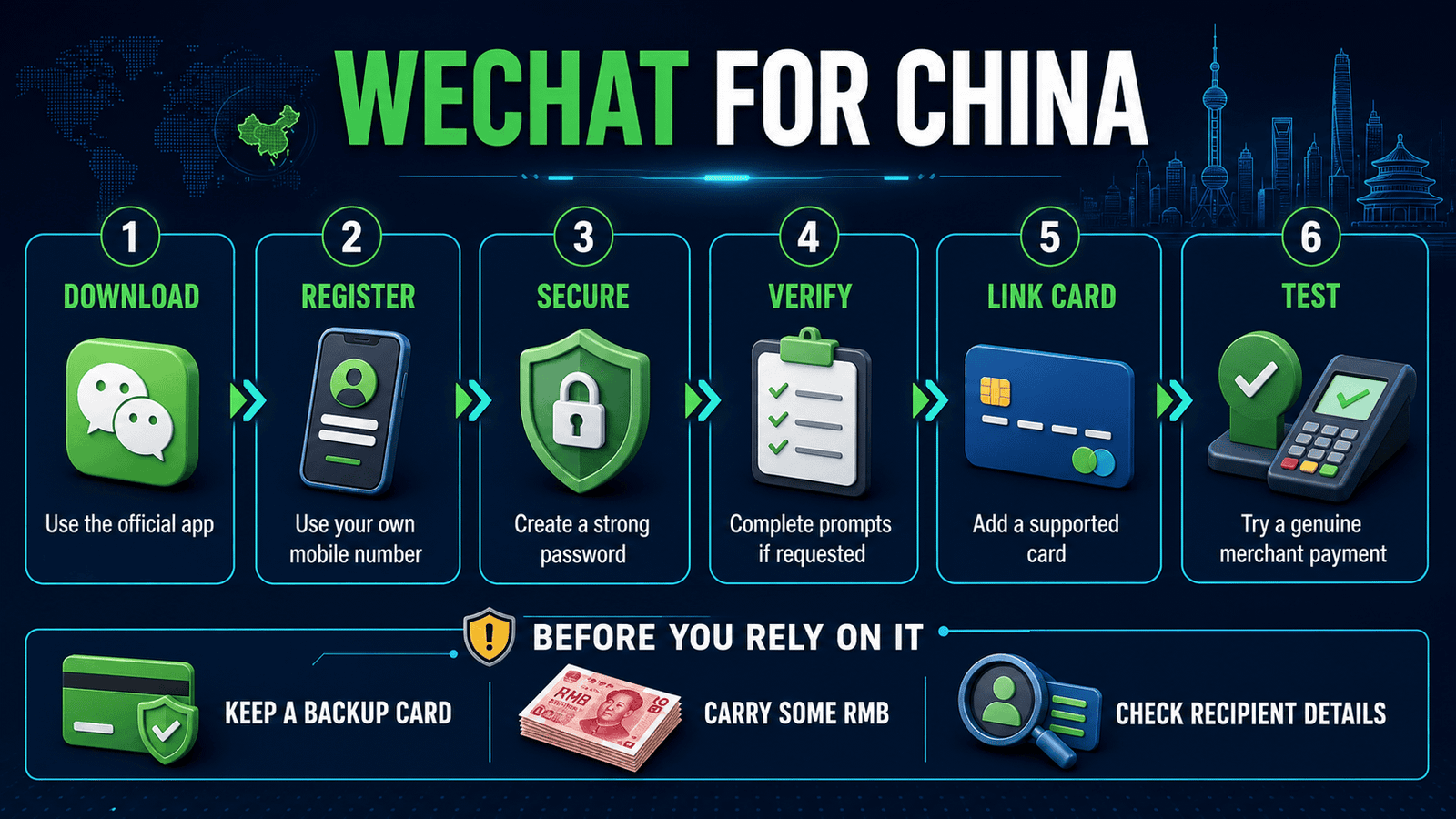
Foreign visitors should prepare WeChat as one component of a broader China-ready setup. Install it before travel, secure the account, add essential contacts and test intended functions. Keep a second payment card and some RMB cash because no single mobile payment route should be treated as infallible. Hotel Wi-Fi, mobile connectivity, card fraud controls or account risk checks can interrupt an otherwise normal transaction.
How to set up WeChat safely
1. Download the official application
Use the official Apple App Store, Google Play listing or a download route linked from WeChat’s official website. Avoid modified packages and download links sent by strangers. Confirm the publisher, review the permissions requested by the app and keep the operating system updated. A compromised installation undermines every security measure that follows.
2. Register with a number you control
Choose a mobile number that can reliably receive SMS messages and that you expect to keep. Enter the country code carefully. Do not register using a temporary number supplied by an online seller; losing control of the number can make account recovery difficult and may cause future risk checks.
3. Complete the prompts shown to your account
Registration and verification flows can vary. WeChat may request security checks, identity information or assistance from an existing eligible user. Follow only the instructions presented inside the official app. Nobody legitimate should ask for your password, SMS code, payment PIN or remote control of your phone.
4. Establish account security
Create a strong password that is not reused elsewhere. Review linked devices, privacy settings and methods of account recovery. Add contacts deliberately rather than accepting every request. If the app offers security notifications or device management, check them before travel.
5. Configure payments only if needed and eligible
Open the payment area available to your account and follow its current identity and card-linking process. The name attached to identity verification should correspond with the required documentation and cardholder information. Banks sometimes block the first cross-border or mobile-wallet transaction, so ensure your issuer has a working contact method.
6. Test ordinary functions in advance
Send a message, make a call and confirm that notifications work. If planning to use WeChat Pay, conduct a legitimate low-value merchant payment where supported rather than sending money to a stranger merely to “activate” the account. Test Mini Programs needed for transport or bookings, but expect that location and local-service requirements may change what works after arrival.
How WeChat is used in everyday life in China
For social communication, WeChat is often the default method of maintaining contact. Friends exchange voice messages, families operate group chats and colleagues coordinate schedules. Contact exchange frequently happens through QR codes rather than business cards. Because personal and professional relationships can coexist on the same platform, users should pay attention to profile presentation, Moments visibility and message tone.
For travel, a hotel may communicate directions through chat; an attraction may sell tickets in a Mini Program; a restaurant may manage queues with a QR code; and a transport provider may expose services inside the ecosystem. International travelers should not assume every interface has a complete English translation. Screenshot translation, a trusted local contact or an alternative booking route can be useful when an essential service is Chinese-only.
For shopping and dining, users may scan codes to view menus, place orders, join loyalty programs or pay. The QR code is therefore more than a payment symbol. Before scanning codes placed in public spaces, inspect whether the destination matches the establishment. Fraudsters can place replacement stickers over legitimate codes.
For public and administrative services, availability is highly local. Healthcare bookings, utilities and municipal tools may be delivered through Mini Programs, but they can require a domestic number, local identity, a resident record or Chinese-language input. A foreign visitor should treat access as a convenience when available, not as a guaranteed entitlement attached to the basic app.
For content, Official Accounts and Channels connect institutions, brands and creators with audiences. Users can follow news, product education, entertainment and service updates. As on any large content platform, publication inside WeChat is not proof of accuracy. Verify financial, medical, legal and travel claims against authoritative sources.
WeChat for business, suppliers and customer relationships
WeChat’s business value begins with continuity. Email exchanges can be slow, while marketplace accounts may disappear when a relationship moves beyond a platform. A correctly identified WeChat contact can provide a persistent conversation channel for quotations, production photographs, delivery updates and post-sale questions. This convenience should supplement—not replace—formal commercial records.
Supplier communication
Importers commonly use chat to clarify product specifications, request images, arrange video calls and receive rapid status updates. Group chats can bring together buyers, sourcing agents, factory representatives and logistics providers. Important decisions should be summarized and confirmed in a purchase order, contract or email. Chat messages can help show context, but they are a poor substitute for a version-controlled specification.
Identity and impersonation risk
A familiar avatar and display name are not proof that the person controlling an account is still the same. If bank or payment instructions change, verify them through a second established channel. Call a known number, confirm with a previously verified manager or check an official company domain. Business email compromise has a social-messaging equivalent: an attacker only needs to convince the payer that a changed recipient is legitimate.
Official Accounts and content
Brands use Official Accounts to publish educational material, product announcements and service menus. The strongest programs connect public information with private customer support rather than treating WeChat as a broadcast-only channel. International businesses should plan for Chinese-language editing, response ownership and compliance instead of opening an account with no operating process.
Mini Programs and commerce
A Mini Program can deliver catalogs, membership, ordering, appointments and after-sales support. Its advantage is proximity to communication: a service can be shared directly into a conversation. Development and operation require more than translating an existing website. The organization must consider account eligibility, hosting and data rules, payment integration, customer support and the expectations of users inside the Weixin ecosystem.
WeCom and structured operations
When customer relationships need employee ownership, auditability and team workflows, WeCom may provide a more structured business environment than personal accounts. Companies should establish rules for who owns contacts, how staff departures are handled and where legally significant records are retained.
A sensible supplier-chat protocol
- Verify the contact through the supplier’s official domain or established marketplace account.
- Label group members by real role and company.
- Keep purchase orders, invoices and inspection reports outside chat.
- Confirm any recipient or bank-detail change through a second channel.
- Never treat a payment screenshot as final settlement evidence.
- Record transaction identifiers and obtain recipient confirmation.
Privacy, security and scam awareness
WeChat combines social identity, communication, service discovery and potentially payment activity. That concentration makes privacy settings and account security important. Users should begin with the privacy policy and terms applicable to their own service version, then limit access according to need.
Contact discovery controls affect whether people can find an account through its phone number or other identifiers. Moments visibility affects how much personal history a new contact can see. Mini Programs may request profile, location, phone or other data. Permissions should be reviewed in context: a mapping tool may reasonably request location during use; an unrelated coupon tool may not need continuous access.
Common scams rely on urgency and borrowed trust. An account may claim that a friend is stranded, a supplier has changed bank details, a parcel requires a fee or an account will be closed unless the user verifies immediately. Pause and confirm through another channel. Do not disclose SMS codes, passwords or payment PINs. Do not install remote-access software at the direction of “support.”
QR codes deserve special caution because they hide the destination until scanned. A code can lead to a contact, group, website, Mini Program or payment request. Check the resulting identity and action before continuing. For payments, confirm the recipient name and amount on the final screen. If the recipient is a business, the displayed identity should make sense in the commercial context.
Account security also depends on the device. Use a screen lock, update the operating system and avoid rooting or jailbreaking a device used for payments. Review active sessions after losing a phone or using a shared computer. Back up essential business documents independently; chat history should not be the only copy of evidence required for accounting, disputes or customs.
Why WeChat accounts are restricted or functions fail
Restrictions can result from security signals, unusual login behavior, suspected spam, prohibited activity, complaints, payment risk controls or inconsistencies in verification data. A new account that adds many strangers, joins numerous groups or sends repeated promotional messages may resemble automation. Rapid device, country or phone-number changes can also look suspicious.
Payment failures have additional layers. The card issuer may decline the transaction; the merchant may not support the relevant card-funded route; the amount or category may trigger controls; identity information may not match; or a particular function may be limited to eligible domestic accounts. Repeating the same failed payment many times can make diagnosis harder and may trigger further risk review.
If an account is restricted, use the official in-app support and recovery process. Read the precise message, preserve screenshots and provide truthful information. Avoid third parties promising paid “unblocking,” since they may steal credentials or worsen the restriction. A legitimate resolution cannot be guaranteed by someone contacting you through an unofficial channel.
WeChat compared with WhatsApp, Alipay and other platforms
| Platform | Primary identity | Strongest use | Key difference |
|---|---|---|---|
| Communication-centered super-app | China-connected relationships, content, Mini Programs and eligible payments | Integrates private communication with a broad service ecosystem | |
| Messaging and calling | International personal and business communication | Generally less integrated with everyday services and embedded apps | |
| Alipay | Payment and lifestyle platform | Payments, merchant services, travel and financial/lifestyle functions | Payment-centered rather than relationship-centered |
| Telegram | Messaging, channels and communities | Large communities, broadcasts and cross-device communication | Different identity, commerce and moderation model |
| WeCom | Enterprise communication | Employee collaboration and structured customer operations | Designed for organizations rather than replacing a personal WeChat identity |
WeChat and Alipay overlap significantly in QR payment, Mini Programs and daily-life services, but their centers of gravity differ. WeChat begins with relationships and communication; Alipay begins with payment and financial-service infrastructure. Many people in China use both. Travelers should prepare both when practical because merchant acceptance, card behavior and particular services can differ. Read the companion complete guide to Alipay for a comparable overview.
Practical troubleshooting
The SMS code does not arrive
Recheck the country code and number, verify mobile signal and wait before requesting repeated codes. Confirm that the carrier permits international or application-generated SMS. Restarting the device or temporarily disabling aggressive spam filtering may help, but do not share a received code with anyone.
Registration asks for additional verification
Follow the exact official prompt. Requirements can vary, and an existing user may not always qualify to assist. Do not pay strangers to perform verification. If the process cannot be completed legitimately, use official support rather than creating multiple accounts in rapid succession.
A contact cannot be added
Confirm the WeChat ID or ask the person to share a current contact card or QR code through a trusted channel. Privacy settings, request limits or temporary security controls may prevent discovery. Avoid repeated requests, which can resemble spam.
A Mini Program will not open
Update the app, check connectivity and search for the Mini Program by its verified name. Some programs are restricted by location, account type, language, identity or service availability. Never sideload a separate app from an unknown link merely because a Mini Program fails.
A linked card is declined
Check that the card information and identity details are correct. Contact the issuer using the number on the card, confirm cross-border and digital-wallet transactions are permitted, and try a different eligible card if appropriate. A successful card link does not guarantee every merchant transaction.
A payment shows pending
Do not immediately pay again. Check the transaction record, issuer activity and merchant status. Ask the merchant to confirm through its own system. Preserve the order number and payment record, and use official support if the status does not resolve.
A recipient says no money arrived
Distinguish between a payment attempt, a completed payment and a screenshot. Review the transaction status and recipient identity. For supplier settlement, follow a documented process and the guidance on what to do when an Alipay or WeChat Pay recipient cannot receive RMB.
Where WeChat is heading
The direction is deeper integration rather than a return to simple messaging. Tencent describes an ecosystem connecting chat, Moments, Official Accounts, Video Accounts, Mini Shops, Mini Programs, payments and search. Artificial intelligence is being applied to content, advertising, customer service and development tools. Cross-border Mini Program activity and international payment connections are also expanding.
That evolution creates convenience but increases the importance of clear boundaries. Users need to understand whether they are communicating privately, publishing publicly, authorizing a third-party Mini Program or approving a financial transaction. Businesses need governance for identity, customer data, staff access and records. Regulators and platform operators will continue to influence what services are available to which accounts.
WeChat’s enduring advantage is not any single feature. It is the low friction between features. A message can lead to content, a service and a transaction in a few steps. The same quality also creates risk when users move too quickly. The skill required is not merely knowing where buttons are; it is recognizing which party, permission and financial relationship is active at each step.
Frequently asked questions about WeChat
Is WeChat free?
The app can generally be downloaded and used for messaging without a subscription charge, but mobile data, calls, third-party services, merchant purchases and payment-related fees may apply. Check the relevant provider and confirmation screen.
Is WeChat the same as Weixin?
No. Tencent identifies them as separate but interoperable sister services: Weixin is designed for mainland-China users and WeChat for users elsewhere. They share an ecosystem and can communicate, but terms and features can differ.
Do I need a Chinese phone number?
Not necessarily. International registration is supported with eligible foreign mobile numbers. Certain domestic services may still require a mainland number or other local credentials.
Can I use WeChat in English?
WeChat supports multiple interface languages, including English. Content supplied by contacts, Official Accounts and third-party Mini Programs may remain Chinese-only.
Can foreigners use WeChat Pay?
Many international visitors can access eligible merchant payments after completing the current setup and verification requirements and linking a supported card. Availability is not universal, and some transfers or wallet functions may remain restricted.
Can I send money to any WeChat user?
No assumption should be made. Person-to-person transfer eligibility differs from merchant payment capability and may depend on both accounts. Confirm the recipient route before arranging a payment.
Is WeChat safe?
WeChat provides account and payment security controls, but safety also depends on device security, truthful registration, cautious permission use and resistance to impersonation, phishing and QR-code scams.
Does WeChat replace email for business?
It can accelerate communication, but contracts, specifications, invoices and formal approvals should also be maintained in durable business systems outside chat.
What is a Mini Program?
It is a lightweight service running within Weixin or WeChat. Users can access Mini Programs through search, sharing or QR codes without installing a conventional standalone application.
What should I do before traveling to China?
Install the official app, secure and test the account, add essential contacts, prepare a second payment method, carry some RMB and save critical addresses offline.
The bottom line
WeChat is best understood as China’s relationship layer for digital life. Messaging remains its foundation, but its practical power comes from the connections between people, publishers, businesses, Mini Programs, services and payments. For an international user, the right approach is preparation without overconfidence: build the account under your own identity, secure it, test the functions you genuinely need, verify every recipient and retain backup communication and payment options.
For businesses, WeChat can shorten distance and strengthen supplier or customer relationships, but speed must not erase controls. Preserve formal records, confirm changed payment details independently and separate conversation convenience from financial authorization.
Primary sources and further reading
- Tencent: Weixin and WeChat product overview
- Tencent: Weixin Mini Programs
- Tencent investor reports
- Official WeChat website
- WeChat privacy policy
Feature availability, eligibility, fees and limits can change. Verify operational details in the current app, the applicable terms and the relevant bank or merchant confirmation screen.