
A safe supplier payment begins with matching documents. Before an international buyer sends bank TT, Alipay, WeChat Pay or USDT for RMB settlement, the commercial record and the recipient instruction should tell one consistent story: who is selling, who is buying, what is being purchased, how much is due, why it is due and where the money must arrive. A polished invoice alone is not proof of legitimacy, but a broken document chain is a warning that deserves investigation.
This guide explains the practical file a buyer should build from quotation to reconciliation. It is designed for importers who want faster settlement without losing control of invoices, approvals and audit evidence. It does not replace tax, customs, legal or accounting advice in the buyer’s country.
The complete Chinese supplier payment-document checklist
The strongest file is not the largest file. It is a concise set of records that agree with one another. A practical folder normally contains the supplier quotation, proforma invoice, buyer purchase order or written acceptance, recipient instructions, approval record, quote or rate confirmation, transfer evidence, RMB payment slip, supplier acknowledgement and the final commercial or shipping records. Each item answers a different question, and together they make an error easier to detect.
1. Supplier quotation
The quotation establishes the commercial starting point. It should identify the supplier, product, specification, quantity, unit price, total, currency, Incoterm where applicable, validity period, expected production time and proposed payment terms. Buyers should not treat a chat message containing only a total as a complete quotation. If tooling, samples, freight, packaging or inspection is charged separately, those items should be visible.
2. Proforma invoice
A proforma invoice is usually a request for payment before shipment; it is not automatically the final tax or commercial invoice. It should show a unique number and date, buyer and supplier names, item description, quantities, unit prices, total and currency, payment schedule, delivery term and recipient instructions. The entity named as seller should have an intelligible relationship with the beneficiary. If a factory asks payment to a trading company, owner or service company, request the reason in writing and retain it.
3. Purchase order or written acceptance
The buyer’s purchase order converts negotiation into an internal commitment. It should repeat the approved specification, quantity, price, delivery requirement, quality standard, inspection milestone and payment terms. A small buyer without a formal purchasing system can use a signed order confirmation, but it should still have a reference number and approver. The purchase order prevents a finance colleague from paying a changed invoice that procurement never accepted.
4. Recipient instruction
Bank instructions require the beneficiary name, account number, bank name, branch and any SWIFT, CNAPS or address fields requested for the route. Wallet instructions require the correct Alipay or WeChat Pay recipient identifier and confirmation that the intended person or business can receive the amount. Copy details directly, then verify them through a second trusted channel. Never approve a last-minute change solely because an email looks familiar.
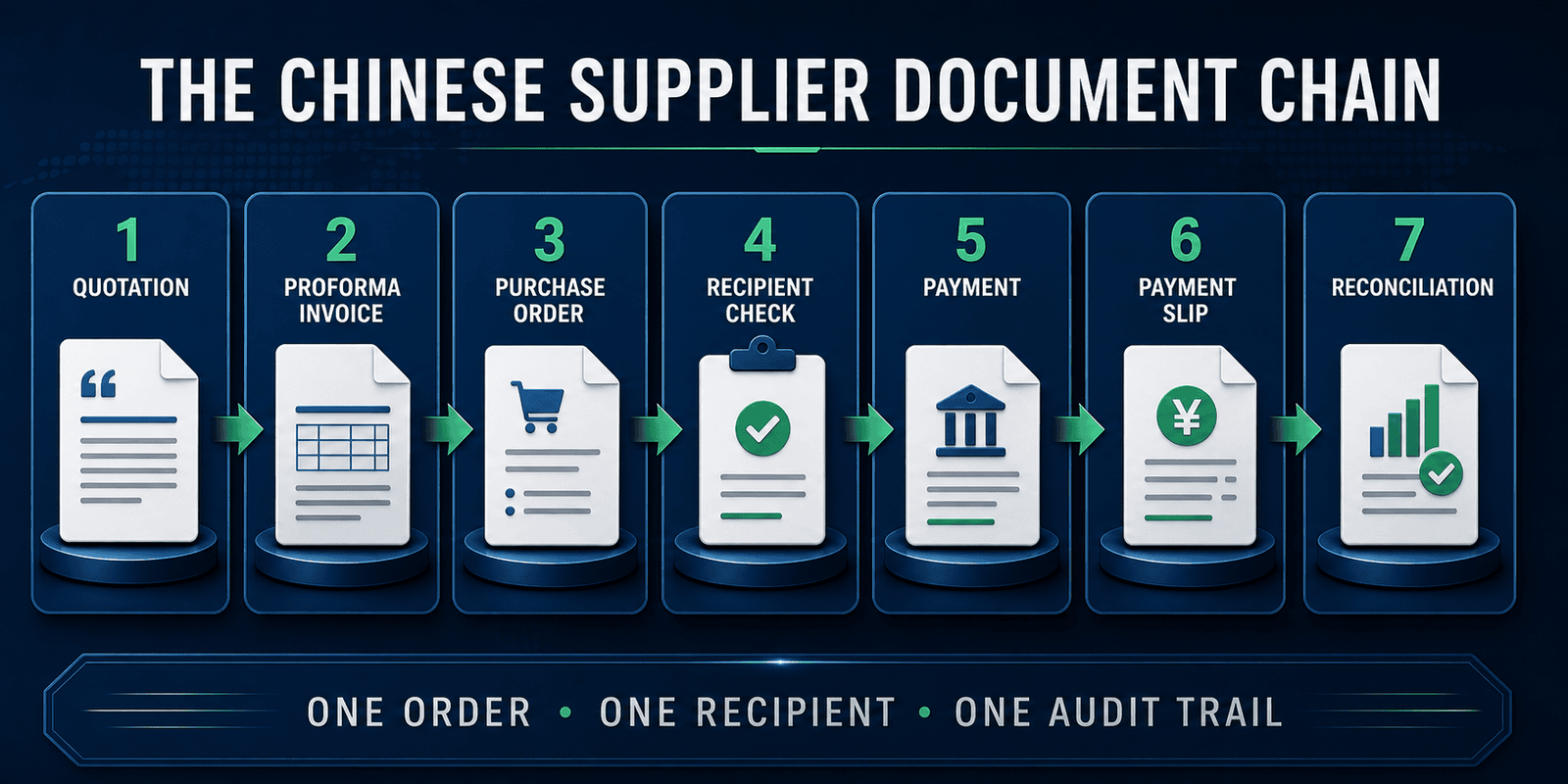
5. Internal payment approval
The approval record should state the order, invoice, supplier, recipient, amount, currency, payment milestone and approver. It can be a signed form, controlled spreadsheet entry or approval inside an accounting platform. Larger teams should separate the person who creates the supplier record from the person who releases payment. Smaller teams can use a callback and a written two-step checklist.
6. Quote and settlement confirmation
When ExtentExchange is used, the buyer should preserve the confirmed RMB amount, USDT amount, token network, destination wallet, quote-validity window, recipient route and service terms as one transaction record. USDT on different networks is not interchangeable merely because the ticker is the same. The buyer should compare the destination immediately before sending and save the transaction hash after broadcast.
7. Payment slip and supplier acknowledgement
A slip demonstrates that the requested RMB payment was executed; it is not by itself proof that the supplier allocated funds to the correct order. Match the recipient, amount, date and reference, then ask the supplier to confirm receipt against the invoice or purchase order. If the supplier reports a shortfall or missing allocation, preserve the exact message and avoid sending a second payment until the first route is traced.
8. Final commercial, inspection and shipping records
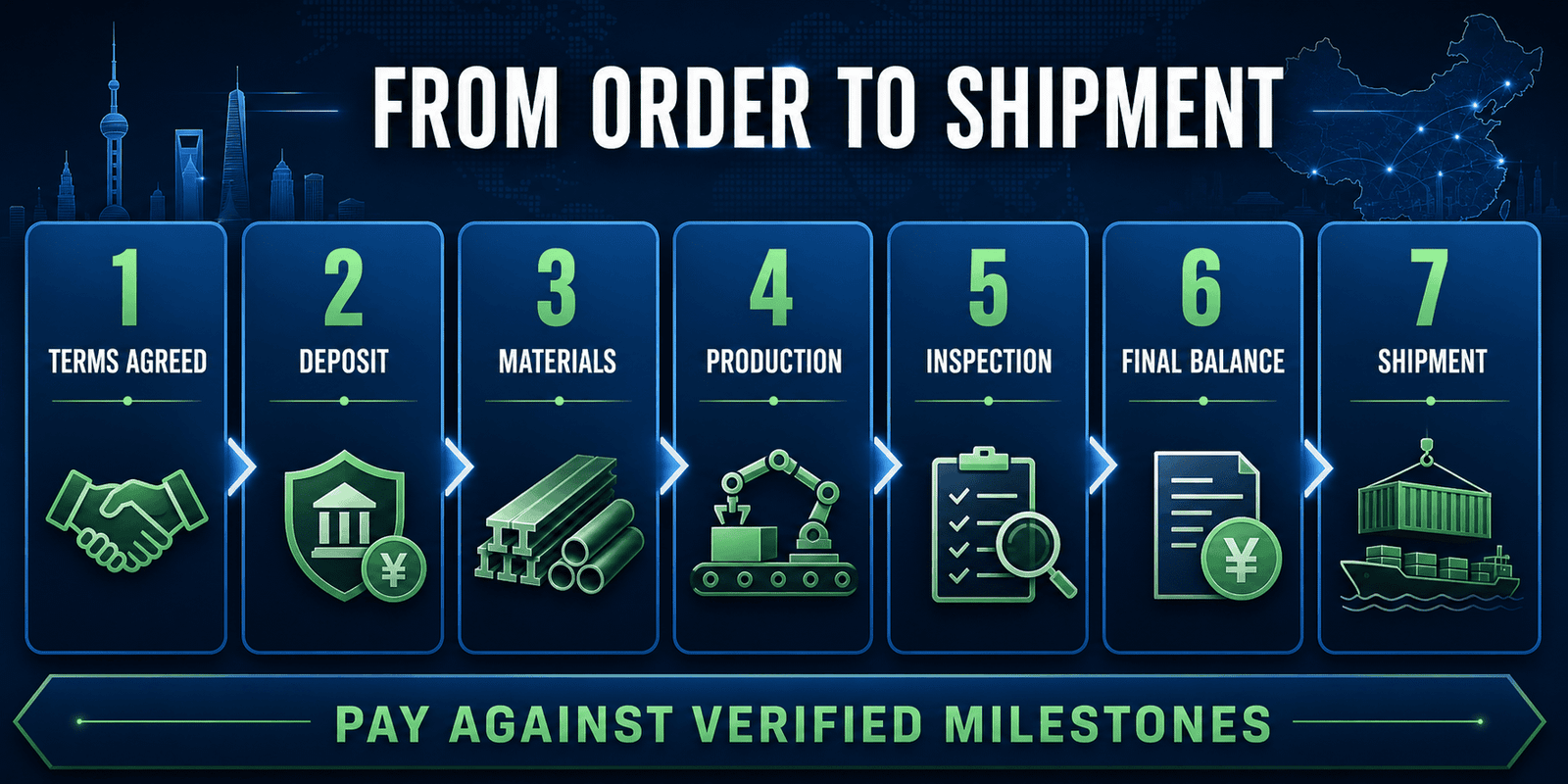
The documentation trail continues after payment. Retain inspection reports, packing list, commercial invoice, bill of lading or airway bill, customs information, delivery confirmation and any debit or credit note. These records help explain why a balance was released and support landed-cost accounting. They also matter if quantity, quality or delivery is disputed.
ExtentExchange’s role in the document chain
ExtentExchange focuses on the settlement leg: the buyer provides the RMB amount, route and usable recipient details; ExtentExchange confirms a quote and USDT network; after correct USDT is confirmed, the RMB payment is executed and a payment slip is returned. The service does not certify product quality, supplier ownership, customs value or tax treatment. Those commercial decisions remain with the buyer.
For Alipay or WeChat Pay below RMB 10,000, the confirmed service fee is RMB 50. At RMB 10,000 or above, there is no separate service fee, while the buyer still approves the live conversion quote. Chinese bank TT has a minimum of 5,000 USDT. After correct funding and usable recipient details are confirmed, the wallet-payment slip is guaranteed within one to two hours and the bank-TT slip within twenty-four hours.
Invoices or supporting documents may be requested where required, although this is uncommon in routine cases. Buyers should therefore keep truthful transaction records available. The purpose is operational clarity and lawful risk control, not avoiding tax, sanctions, customs rules or legitimate compliance review. ExtentExchange does not promise anonymous or undocumented settlement.
What to send when requesting settlement
A complete request normally states the RMB amount, intended recipient, route, payment purpose, invoice or order reference, deadline and any wording the supplier needs. For bank TT, send the beneficiary fields exactly as supplied. For Alipay or WeChat Pay, confirm the recipient can receive the intended amount. If names differ between the invoice and recipient, explain the relationship before funding.
The buyer can reduce delay by preparing the recipient check before requesting the quote. Relevant guides include the Alipay recipient checklist, WeChat Pay recipient checklist and Chinese bank beneficiary checklist. The broader Chinese supplier payment guide compares the available routes.
Frequently asked questions
Is a proforma invoice enough to pay a supplier?
Not on its own. Match it with the accepted quotation or purchase order, verified recipient instruction and approval record. For a new supplier, complete due diligence and consider inspection or staged terms.
Must the beneficiary name equal the supplier name?
A match is simplest, but legitimate groups sometimes use a related factory, trading company or collection entity. Obtain a written explanation and independently verify it. An unexplained change is a reason to stop.
What if the supplier changes bank details after invoicing?
Do not rely on the message that announced the change. Contact a known representative through a previously verified channel, confirm the full details and record who approved the update.
Does a payment slip replace an invoice?
No. The invoice explains the commercial obligation; the slip records payment execution. Keep both, plus supplier acknowledgement and the transfer or transaction identifier.
How long should records be kept?
Follow the tax, customs, accounting and limitation rules applicable to the buyer and transaction. Where uncertain, obtain professional advice rather than deleting records after delivery.
Implementing a new payment workflow within a company involves more than choosing a payment method — it requires operational infrastructure, team training, compliance coordination, finance department alignment, and ongoing process management. When the payment method in question is USDT settlement through a professional OTC desk, these implementation considerations apply equally to traditional methods but with additional complexity around documentation standards, team education, and risk management protocols.
Establishing USDT settlement as your company’s internal procurement payment workflow for China suppliers requires four interconnected components: desk selection and onboarding, internal payment process design, team training and compliance coordination, and vendor transition management.
This guide covers the complete implementation lifecycle — from selecting a professional desk through establishing operational procedures, training your procurement team, coordinating with finance, onboarding Chinese vendors to the new system, and optimizing your workflow as you scale. It is written for operations leaders who need to implement USDT settlement as an organizational capability, not just as an individual convenience.
Phase 1: Desk Selection and Onboarding
Evaluating Professional Desks for Organizational Use
Not all professional OTC desks are structured equally for company-scale use. When evaluating desks for internal implementation, assess the following criteria:
| Evaluation Criterion | What to Ask | Why It Matters |
|---|---|---|
| Multi-user account support | Can multiple team members access settlement records? Is role-based access available? | Your procurement team needs operational access; finance needs reporting access; you should control approval authority |
| Standing RMB liquidity | What is the desk’s typical standing RMB liquidity level across all settlement routes? | Large or high-volume company settlements require guaranteed liquidity at confirmed rates |
| Multi-route coverage | Does the desk support Alipay, WeChat Pay, and Bank TT? | Different Chinese vendors prefer different channels — your desk must cover all of them |
| Onboarding timeline | How long does full KYC onboarding take for a company account? | Implementation planning depends on knowing whether onboarding takes 1 day, 3 days, or a week+ |
| Compliance documentation flexibility | Can the desk accept your company’s standard commercial documentation formats? | Desks that require non-standard documentation create friction during implementation |
| Proactive compliance management | Does the desk proactively notify you when documents need renewal? | Prevents settlement delays caused by expired KYC or compliance materials |
Company Onboarding Process
When your company registers with a professional OTC desk, the onboarding process typically involves:
- Company identity verification: Business registration documents, government-issued ID for authorized signatories, proof of business address
- Compliance documentation standards agreement: Establishing which types of commercial documentation your desk will accept for different transaction categories (goods vs services, standard amounts vs elevated amounts)
- Recipient pre-verification setup: Optionally submitting your key Chinese vendors’ information to the desk before your first settlement so they are verified and ready when you initiate payments
- Team access configuration: Setting up user accounts with appropriate permission levels (requestor, approver, executor, viewer)
Professional desks that serve company-scale buyers typically complete standard onboarding within 1-3 business days. For urgent situations, some desks offer expedited compliance review for established buyers or new buyers with pre-prepared documentation.
Phase 2: Internal Payment Process Design
Establishing Your Settlement Approval Workflow
Your company’s internal payment approval process must be adapted to incorporate USDT settlement alongside any existing payment methods. A typical workflow looks like this:
| Step | Actor | Action | Timeline |
|---|---|---|---|
| 1 | Procurement coordinator | Identify vendor payment need; prepare commercial documentation (invoice, contract, milestone sign-off) | As needed per purchase order |
| 2 | Finance approver | Review commercial documentation for accuracy and budget alignment | Same day or next business day |
| 3 | Designated settlement operator | Submit settlement request to desk with documentation; receive confirmed quote | Within 15-30 minutes at the desk |
| 4 | Authorized executor | Transfer USDT to desk’s confirmed wallet address during 2-hour confirmation window | Within 2 hours of quote confirmation |
| 5 | Desk processing | Verify USDT receipt; disburse RMB to vendor via their preferred channel | Typically 30 minutes to 2 hours after USDT confirmation |
| 6 | Internal record-keeping | Procurement coordinator files desk confirmation + TXID + commercial docs in payment tracking system | Within 1 business day of settlement completion |
Defining Payment Thresholds and Approval Levels
For companies settling multiple amounts monthly, establishing internal threshold guidelines helps manage compliance efficiently:
| Monthly Settlement Volume | Recommended Internal Process |
|---|---|
| Under $10,000/month | Single approval sufficient; designated operator handles desk communication directly |
| $10,000–$50,000/month | Dual approval (procurement + finance); desk establishes enhanced compliance review on file |
| $50,000+/month | Dedicated desk relationship with standing liquidity confirmation; priority queue access for urgent settlements; enhanced documentation protocols |
Settlement Scheduling and Rate Monitoring
Establishing a regular settlement schedule within your company’s operations:
– Weekly settlements: Ideal for companies with recurring weekly vendor payments — request desk quotes at the start of each week, execute during established windows
– Bi-weekly settlements: Aligns with most corporate payroll and procurement cycles
– Monthly settlements: Works for companies that consolidate multiple vendor payments into single monthly settlements
– Ad-hoc/urgent settlements: Maintain protocol for time-critical payments that cannot follow standard scheduling
Professional desks typically provide indicative rate displays that your finance team can monitor to optimize settlement timing without committing to a rate until the official quote request.
Phase 3: Team Training and Compliance Coordination
Procurement Team Training
Your procurement team needs training on the following operational components:
| Training Topic | Key Points |
|---|---|
| Desk communication protocols | How to submit quote requests, what documentation to provide, how to confirm settlement details with desk operators |
| Commercial documentation standards | Which documents your desk accepts for each transaction type; formatting requirements that expedite compliance review |
| Payment execution procedures | How to verify desk wallet addresses (always confirmed in writing by the desk — never from email or chat alone); how to track TXID records |
| Recipient management | How to submit new vendor payment details to the desk for pre-verification; maintaining updated recipient documentation |
Finance Team Coordination
Your finance team needs alignment on several areas:
Currency Accounting Treatment:
Professional desk settlement settles in USDT (pegged to USD) and disburses RMB. Your finance team must determine the appropriate accounting treatment for these settlements — including how to record the USD-to-RMB conversion rate, when to recognize any FX gain or loss, and how to document the transaction for audit purposes.
Reporting Integration:
Desk settlement records (TXID + desk confirmation + commercial documentation) integrate into your company’s existing payment tracking system the same way bank wire receipts do — with additional verification layers from the desk’s compliance process that support more thorough audit trails.
Risk Management:
Professional desk settlement introduces minimal new financial risk because:
– Settlement amounts are confirmed and locked before any transfer
– Network fees (TRC20) are fixed regardless of transaction size
– Desk-side compliance verifies recipient legitimacy before disbursement
– On-chain TXID provides immutable payment verification
Phase 4: Vendor Transition Management
Onboarding Chinese Vendors to the New Payment System
Your Chinese vendors will not need to change their behavior — they receive RMB through their existing payment channels (Alipay, WeChat Pay, or bank account) exactly as they would from a domestic buyer. What changes is how you fund those payments:
| Vendor Type | Transition Step | Vendor Experience |
|---|---|---|
| Vendors who currently receive Alipay payments | Send vendor’s Alipay QR code to desk for pre-verification | No change — they still see RMB land in their Alipay balance |
| Vendors who currently receive WeChat Pay | Send vendor’s WeChat Pay ID for pre-verification | No change — same payment experience from the vendor’s perspective |
| Vendors who currently receive bank transfers | Send vendor’s bank account details to desk for pre-verification | Slightly different timing — RMB arrives hours faster than traditional wire clearing |
The key message to communicate to your Chinese vendors: “We are upgrading our international payment process. Your receiving details do not change. You will continue to receive RMB in your usual payment method, but payments will arrive faster.”
Proactive Vendor Communication
Before switching your China payment workflow to USDT settlement:
– Notify your key vendors that you will be changing your international payment method and confirm their current Alipay/WeChat/bank details are current
– Settle a test amount to each vendor before committing full order values — this verifies their receiving details work correctly with the desk’s disbursement process
– Establish ongoing contact channels with vendors about any receiving issues (rare, but helpful during the transition period)
Ongoing Workflow Optimization
Monthly Settlement Review
Once your USDT settlement workflow is operational, establish a monthly review process:
| Review Component | What to Evaluate |
|---|---|
| Total cost comparison | Desk fees + spread vs. what you would have paid through traditional banking for the same settlements |
| Settlement timing performance | Time from payment request to vendor receipt — how many settled within expected windows? |
| Vendor satisfaction | Any receiving issues reported by vendors? Any questions about new payment method? |
| Compliance documentation completeness | Are all settlement records filed correctly? Any compliance renewals approaching? |
| Desk relationship status | Is your desk meeting your volume profile expectations? Any rate tier improvements to negotiate? |
Scaling Your Settlement Infrastructure
As your company’s China procurement volume grows:
– Request volume tier pricing from your desk based on actual monthly settlement volume
– Establish priority queue access for urgent settlements through high-volume or enhanced compliance standing
– Add new settlement routes as your vendor base expands (if new vendors require channels not currently supported by your desk)
– Build relationships with a backup desk for reliability — primary desk handles routine settlements; backup desk is pre-onboarded for contingency
Summary: Implementation Checklist
| Phase | Key Action Items |
|---|---|
| Desk Selection | Evaluate desk liquidity, route coverage, onboarding timeline, multi-user support |
| Company Onboarding | Submit business documents, establish compliance standards, pre-verify key vendors |
| Process Design | Define approval workflow, set internal thresholds, establish settlement schedule |
| Team Training | Train procurement on desk communication; align finance on accounting and reporting |
| Vendor Transition | Notify vendors of payment method change; settle test amounts; confirm receiving details |
| Ongoing Optimization | Monthly review of costs/timing/satisfaction; negotiate volume tier pricing; maintain compliance |
Fact-checking sources and scope
This guide provides general operational education, not legal, tax, accounting, investment, or regulatory advice. Rules vary by jurisdiction and transaction. Numerical examples in the manuscript are preserved as illustrative ranges, not current quotes or guaranteed outcomes. Confirm the actual parties, payment purpose, recipient, route, rate, limits, tax treatment, and reporting duties before transferring funds.
Frequently Asked Questions
How long does it take to implement USDT settlement as a company’s internal payment workflow?
Standard desk onboarding for a company account typically takes 1-3 business days depending on documentation readiness. Once your desk is active and your team is trained, the full implementation (desk setup, team training, vendor notification, test settlement) usually completes within one week. Companies with pre-prepared compliance documentation can accelerate this timeline significantly.
Can multiple team members in my company use USDT settlement?
Yes. Professional desks that serve company-scale buyers support multi-user accounts with different permission levels — typically requestor (submits quote requests and documentation), approver (authorizes settlements), executor (performs the actual USDT transfer to the desk), and viewer (finance team access for reporting). Your desk relationship manager can help you configure appropriate access roles for your team structure.
What happens during desk KYC renewal? Professional desks typically notify buyers when their compliance documents are approaching renewal. The renewal process mirrors the initial onboarding — submitting updated business registration, address verification, and authorized signatory identification. Most renewals complete within 1-2 business days.
Can I use USDT settlement alongside traditional bank wires for China payments?
Yes. Many companies maintain both USDT desk settlement and traditional bank wire capabilities and choose the method based on vendor preference, transaction urgency, documentation requirements, or specific compliance needs. Professional OTC desks that serve multi-method buyers support transitions between settlement routes without requiring separate onboarding.
Does USDT settlement require my company to hold cryptocurrency?
Your company acquires USDT from a licensed cryptocurrency exchange and holds it temporarily — typically only for the duration of a single settlement (minutes to hours). You do not need long-term crypto holdings, a dedicated crypto treasury system, or specialized cryptocurrency infrastructure. The USDT exists solely as a settlement funding mechanism that flows through to RMB disbursement within your company’s established approval workflow.
Internal payment workflow implementation requirements may vary by company size, procurement volume, and organizational structure. For details about ExtentExchange’s company onboarding process and desk-side support for multi-user implementation, visit /usdt-to-rmb/ or contact us through our published channels.
Check the current indicative rate information, review the transaction requirements, and confirm the supplier, RMB recipient, payment route, and quote with the desk before sending.