
Alipay ecosystem · Foreign visitor setup
Setting up Alipay as a foreigner is now substantially easier than it once was, but a successful setup still depends on three separate systems working together: Alipay must accept the account, the user must complete any required identity verification, and the overseas card issuer must authorize both card binding and later purchases. This guide explains the entire process from preparation to the first successful payment—and what to do when any step fails.
From download to first payment
Complete the stages in order so that a failure can be diagnosed accurately.
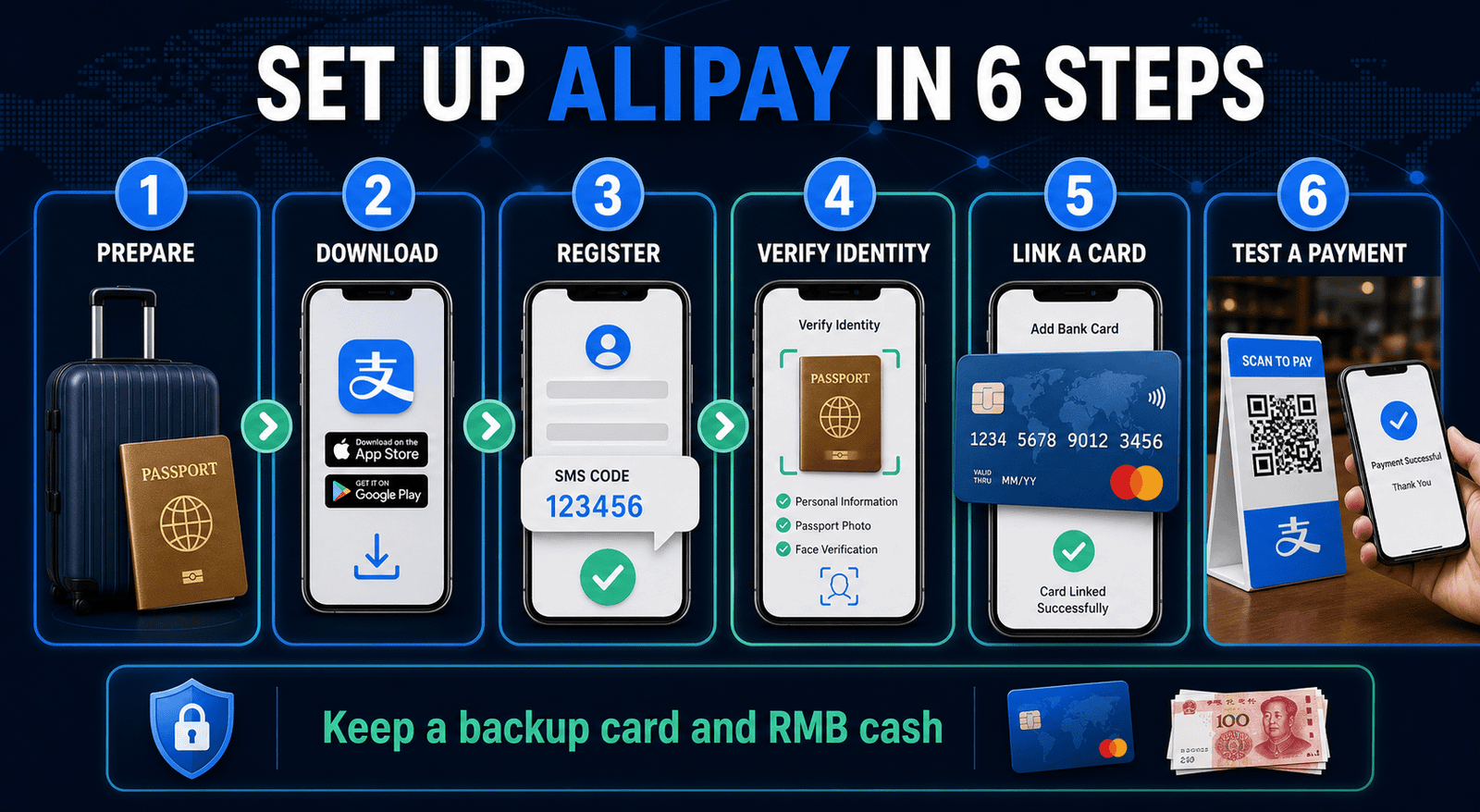
What to prepare before creating the account
Ten minutes of preparation can prevent hours of troubleshooting. Alipay setup involves identity, communications and banking systems. If one component is unavailable during registration, the account can become difficult to complete or recover.
1. A reliable mobile number
China’s official guidance states that foreigners can register mobile-payment applications using foreign or Chinese numbers. Choose a number you control and can continue using. It may receive login, security and recovery codes. A temporary travel SIM that expires immediately after the trip is a weak foundation for a long-term payment account.
Confirm that the phone can receive international SMS. If using dual SIM or eSIM, know which line receives messages. Do not depend exclusively on mobile data: some verification processes require an actual SMS delivered to the registered number.
2. A valid passport
Use a passport that will remain valid for the trip. The identity name in Alipay should match the document. Prepare a clear image of the biographical page, but upload it only through the official app. Never send passport images to a stranger offering “verification assistance.”
3. One or preferably two supported cards
Official Chinese guidance lists Visa, Mastercard, UnionPay, American Express, JCB, Diners Club and Discover among cards that can be bound to payment products, subject to actual product and issuer support. A physical card is useful even when the details are stored digitally.
A second card from another issuer provides redundancy. Two cards on the same network can still behave differently because each bank applies its own fraud controls, international-transaction settings and authentication process.
4. Access to the issuing bank
Install the bank’s official application, confirm the registered phone number and know how to contact support. The issuer may send a one-time password, request approval in its app or block an unfamiliar China-related wallet connection.
5. A secure device and connection
Update the operating system, enable a strong screen lock and avoid completing identity or card setup on public Wi-Fi. Do not use a rooted or compromised device for financial activity. Record recovery information securely, but never store passwords or full card data in an unprotected note.
Pre-install checklist
- Passport is valid and readable
- Mobile number receives international SMS
- Card supports online and international purchases
- Bank app and support access are available
- Full legal name and billing information are known
- Backup card or RMB cash plan is prepared
Download the official Alipay app and register
Step 1: find the official application
Use the Apple App Store, Google Play or another trusted official app-distribution channel available on the device. Inspect the name, icon and developer details. Search advertisements and unofficial download pages can imitate legitimate services.
Avoid APK files sent through social media, private chat or email. A fake payment app can capture identity documents, card data and security codes before the user ever reaches China.
Step 2: choose the correct region and language
The application can offer an international interface or language selection. The exact prompt differs by app version and phone region. Choose the interface that matches the intended use, but remember that third-party mini-programs may still display Chinese text.
China’s official payment guidance reported that Alipay expanded support to 16 languages and introduced translation across several traveller services. Language support improves navigation; it does not change account eligibility.
Step 3: enter the phone number
Select the correct international dialing code and enter the number without adding an unnecessary domestic prefix. Wait for the official verification code. Do not share that code with anyone, including a supposed merchant or support agent.
If no code arrives, check signal, spam filtering, roaming and the number format. Avoid requesting codes repeatedly in rapid succession because rate limiting can delay further attempts.
Step 4: create account security
Use a unique password. Do not reuse the password from email, banking, a cryptocurrency exchange or another wallet. Where available, activate biometric login and payment confirmation, but retain a secure recovery method.
Step 5: review the home interface
After registration, the user may see Scan, Pay/Receive, Transport, Pocket and travel utilities. Our complete Alipay features guide explains those tools. Do not assume that seeing an icon means the account has passed all required checks.
Complete identity verification correctly
Identity verification connects the digital account with a real person. It supports compliance, account recovery, fraud prevention and eligibility decisions. The exact level required can depend on transaction amount, feature and risk assessment.
Enter the legal name exactly
Name mismatches are among the most common setup problems. Passports can contain surname, given names and machine-readable formatting that differs from everyday usage. Follow the fields shown by Alipay. Do not omit a middle name simply because a card prints an abbreviated version.
Users from naming traditions without a conventional Western surname/given-name pattern should follow the app’s document instructions. If the result fails, seek official support rather than trying multiple invented name orders.
Scan or photograph the passport
Use bright, even light. Keep all edges visible and avoid glare across the photograph or machine-readable zone. Do not digitally alter the document image. A blurred or cropped photograph can cause automatic verification to fail.
Complete facial verification if requested
Remove sunglasses, masks and hats. Use natural light and a plain background. Hold the camera steady and follow movement prompts. Facial verification can fail when the device camera is damaged, lighting is uneven or the current appearance differs substantially from the passport photograph.
Understand verification tiers
Not every small transaction necessarily requires the same amount of information, and China has taken steps to simplify visitor payments. Nevertheless, higher-value, unusual or sensitive activity can trigger additional verification. A passport-verified foreign account also does not become identical to an account verified with a Chinese resident identity card.
This difference is particularly important outside the Chinese mainland. Official Alipay merchant guidance states that some overseas in-store payment capability is limited to users authenticated as Chinese residents; passport authentication alone may not qualify. A foreign visitor using Alipay inside China should not assume the same account can make Alipay payments in every other country.
If verification remains pending
Wait for the stated review period. Do not open several accounts or repeatedly upload inconsistent documents. Keep the app updated and monitor official notifications. If support requests clarification, respond through the verified Help Center.
How to link an international bank card
Card linking gives Alipay a funding route for eligible payments. It is not a transfer of the card balance into Alipay, and it does not necessarily create stored RMB.
Open Bank Cards or the add-card flow
The path may appear under Account, Pay/Receive or a setup prompt. Select the option to add a card. Enter the card number carefully or use supported scanning only when the app provides it.
Enter card and billing information
Provide expiry date, security code and requested billing details. The name should reflect the card or identity instructions. Billing-address requirements can vary. Use the genuine address registered with the issuer rather than a hotel or temporary Chinese address unless the bank has changed the account.
Complete issuer authentication
The bank may use 3-D Secure, an SMS code, its mobile app or another challenge. Official Chinese guidance emphasizes that overseas-card binding must be verified by the issuer. Alipay cannot force a bank to approve the connection.
Recognize a verification charge
Some services use a small temporary authorization to verify a card. Check the wording and whether it is pending or settled. Do not confuse a temporary authorization with an unexplained permanent fee. Contact the issuer if it remains or looks unfamiliar.
Select the default card carefully
When multiple cards are linked, inspect the last digits before every significant payment. A default card can change after a decline or manual selection. Consider which card has lower foreign-transaction costs, stronger alerts and better travel support.
| Card-linking result | What it means | Next action |
|---|---|---|
| Card added successfully | Alipay stored an eligible funding credential | Test a small merchant purchase |
| Issuer declined | The bank rejected verification or risk assessment | Contact the issuer; confirm online/international use |
| Unsupported card | Card type, country or product may not qualify | Try another genuinely supported card |
| Name mismatch | Identity and card data do not align | Review exact legal and issuer records |
| Authentication timed out | Bank challenge was not completed | Retry once with reliable connectivity |
Make the first Alipay payment safely
A linked card has passed enrollment, not every future authorization. Test the real transaction path before relying on Alipay for a hotel deposit, train connection or urgent purchase.
Choose a small legitimate merchant purchase
Use an established merchant and an amount you can easily reconcile. Avoid person-to-person transfers as a test because foreign-card funding may not support them. The purpose is to test a genuine retail-payment route.
Merchant code: scan and verify
Open Scan, read the merchant QR code and confirm the displayed merchant or recipient. If the amount is not encoded, type it carefully. Check the funding card, service fee and RMB total before authorization.
Your code: let the merchant scan
Open Pay/Receive and display the payment code to the cashier. Do not send a screenshot or let someone take the unlocked phone away. After the scan, review the result and transaction record.
Verify both sides
A successful animation is useful but the transaction record is more important. The merchant should confirm receipt in its system. If the result is pending, do not immediately pay again. Duplicate payment is a frequent consequence of impatience during a network delay.
Fees, exchange rates and limits
The cost of a card-linked Alipay purchase can involve Alipay, the card network and the issuing bank. These components should be separated.
Alipay service fee
China’s 2024 official foreign-investment guide stated that international-card QR payments not exceeding RMB 200 had no additional user service fee, while payments above RMB 200 carried a 3% fee. Treat those figures as historical official guidance, not a permanent promise. Current prompts and agreements control.
Issuer foreign-transaction fee
The bank can add its own foreign-transaction charge. A card marketed for travel may waive it; another may add a percentage. Alipay does not control that issuer fee.
Currency conversion
The card network or issuer converts RMB into the card currency. The exchange-rate tool visible in Alipay can be informative but may not equal the final posted rate. The processing and settlement dates can differ.
Limits
The 2024 guide referenced a US$5,000 single-transaction limit and US$50,000 annual limit for bound overseas cards. Current official guidance now advises users to rely on the product page for limits and charging standards. Account-specific, issuer and risk limits may be lower.
What a foreign Alipay account can and cannot do
Many visitors can use an overseas card for daily merchant purchases. They should not infer full domestic-wallet capability.
| Function | Typical visitor expectation | Important qualification |
|---|---|---|
| Merchant QR payment | Often supported | Merchant and issuer must accept the route |
| Online or mini-program purchase | Supported in many scenarios | Provider may require local credentials |
| Transport | Available in supported cities | City setup and identity verification may apply |
| Person-to-person transfer | May be unavailable with foreign-card funding | Different from a purchase |
| Receive money | Can be limited | Account and balance eligibility matter |
| Top up Alipay Balance | Do not assume international-card support | Stored value has separate rules |
| Red Packet | May require domestic capability | Not a substitute for merchant checkout |
| Financial products | Often restricted | Residence, identity and regulation apply |
International card versus Alipay Balance
With a linked card, Alipay requests funds from the issuer for an eligible transaction. With Balance, stored value already exists within the wallet arrangement. Refunds, transfers and access rules can therefore differ.
Alipay mainland versus AlipayHK and Alipay+
Alipay, AlipayHK and Alipay+ are related but distinct. Alipay+ connects participating home wallets with merchants. Some travellers can use an eligible home wallet in China without creating a mainland Alipay account. Check the current wallet list and merchant support.
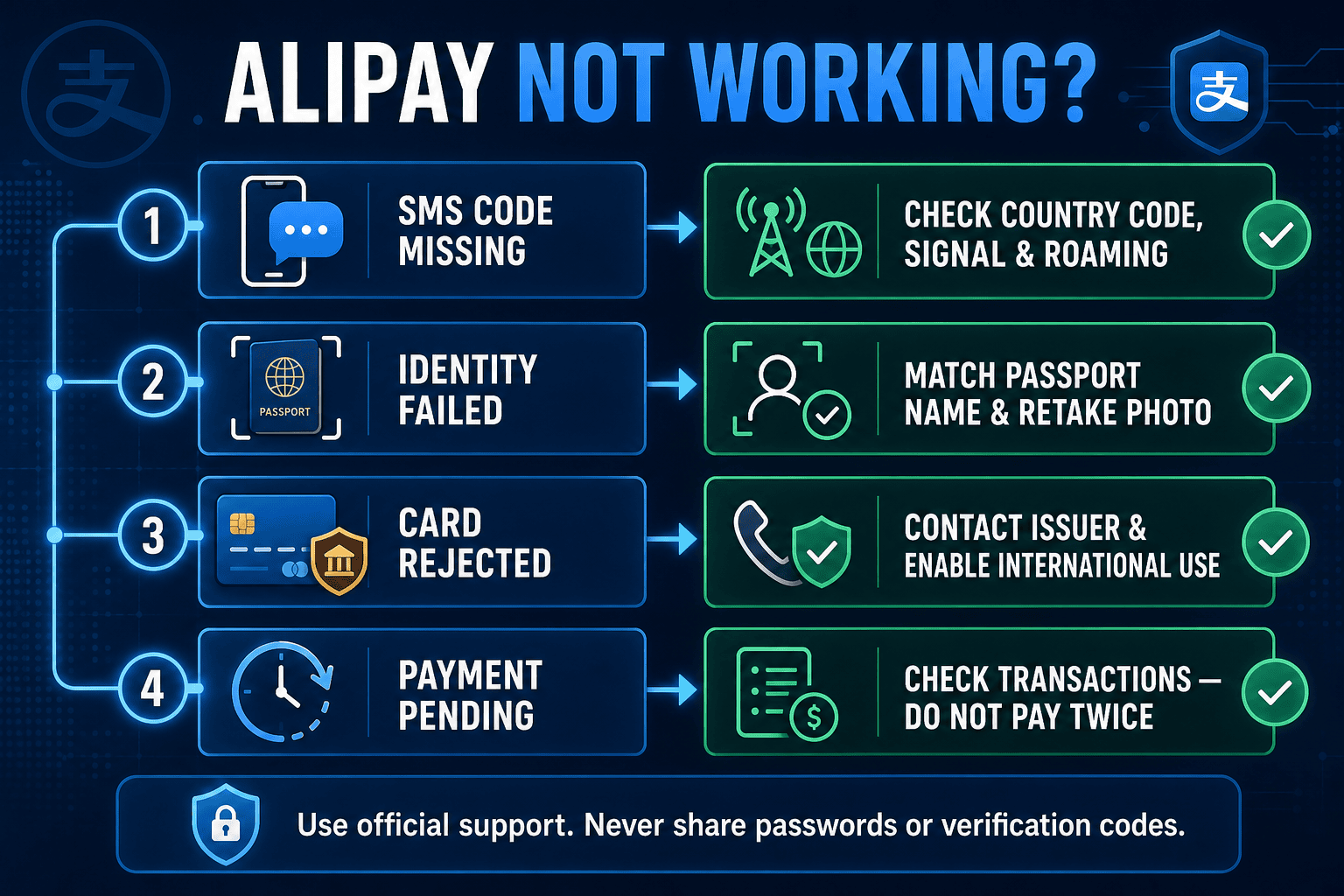
Complete troubleshooting guide
The SMS code never arrives
Confirm the country code, signal, roaming and SMS filtering. Restart the connection and request a code once after waiting. If the carrier blocks international automated messages, contact it. Do not keep cycling through numbers because account recovery later becomes more complicated.
Passport verification fails
Retake the image under even light, include every edge and confirm name order. Check expiry and document type. Facial verification should be performed by the actual passport holder. If repeated accurate attempts fail, use official support.
The card is rejected while adding
Contact the bank and ask whether it sees the enrollment attempt. Confirm international e-commerce, 3-D Secure and wallet provisioning are permitted. Try a second supported card rather than repeatedly submitting the same rejected details.
The card links but payment fails
Enrollment and purchase authorization are separate. Check available credit, issuer alerts, merchant category, amount, current limits and whether the QR code is a personal collection route. Ask the merchant for a standard commercial checkout.
A small payment works but a larger one fails
The issuer or platform can apply amount-based risk controls. The larger payment may also cross a fee threshold or merchant limit. Do not split a payment simply to evade controls. Contact the parties and select an appropriate documented route.
The app shows a blank or Chinese-only mini-program
Core interface translation does not guarantee translation inside every third-party service. Use Alipay’s translation function where available, preserve the original terms and avoid authorizing an agreement you do not understand.
Payment remains pending
Open My Transactions and record the order number. Check the bank for pending authorization. Do not retry until the first transaction is definitively failed or reversed. Contact the merchant and official support when needed.
Refund does not appear
Confirm that the merchant initiated it and obtain a reference. Refunds can pass from the merchant through Alipay, card network and bank. The home-currency amount may differ because of exchange-rate movement.
Account becomes restricted
Read the exact notice. Restrictions can arise from identity inconsistency, unusual devices, repeated failures, rapid transfers, disputed transactions or compliance checks. Do not pay an unofficial “agent” to unfreeze the account.
Security, privacy and scams
Fake application
Install only from a trusted official source. A counterfeit can steal passport and card details.
QR-code substitution
Check the displayed recipient. A printed fraudulent code can be placed over a merchant’s real code.
Fake customer support
Official support does not need the payment password, bank password, cryptocurrency seed phrase or remote control of the phone.
Account rental
Never rent, buy or lend a verified Alipay account. The original owner may recover it, and unexplained money can create serious legal and financial exposure.
Refund redirection
Return money through an appropriate documented route connected with the original transaction. A request to refund another account is a red flag.
Privacy permissions
Payment, travel and mini-program features can process identity, location, card, device and transaction data. Grant only required permissions and review third-party terms.
Prepare Alipay before arrival and use it in China
Set up the account before travel while the registered number, bank and documents are easily accessible. Do not wait until standing at an airport taxi line or hotel desk.
Test connectivity
Plan roaming, local SIM or eSIM service. Keep access to the registered number for security codes. Save critical addresses offline in Chinese.
Activate transport city by city
The Transport feature can require city selection and identity verification. Official guidance explains that foreign travellers can obtain eligible metro and bus codes through Alipay. Carry cash or another ticket method in case setup fails.
Use merchant checkout rather than personal transfer
At shops and restaurants, use Scan or let the cashier scan the Pay code. If a foreign card cannot fund a personal collection code, ask for the merchant’s supported checkout rather than attempting to circumvent the restriction.
Keep payment redundancy
Carry a second card and some RMB cash. Chinese policy supports a diversified environment that includes mobile payment, cards and cash. A lost phone, discharged battery, issuer outage or account review should not leave the traveller unable to pay.
Alipay setup does not automatically solve supplier payments
A visitor account designed for retail purchases is not necessarily the right mechanism for settling a commercial invoice. Supplier payments require recipient verification, commercial documentation and an appropriate route.
Before paying, obtain the invoice, supplier identity, exact RMB amount, verified recipient name and explanation for any third-party wallet. Review our recipient-details checklist and route comparison.
A business payment sent to an employee or relative can create accounting, tax and recovery problems. Large invoices may be more suitable for Chinese bank TT. Never mislabel a commercial transfer as a personal payment to force it through.
Where an eligible customer uses ExtentExchange for USDT-funded RMB settlement, the desk confirms the network, wallet, recipient, purpose, quote and expected RMB before funds move. The customer’s own Alipay setup and the supplier’s ability to receive are separate questions.
Continue through the Alipay knowledge cluster
Frequently asked questions
Can a foreigner create an Alipay account?
Many foreigners can register with an overseas or Chinese phone number and follow the current identity and card-binding prompts.
Do I need a Chinese phone number?
Not necessarily. Official guidance says foreign numbers can be used, but an accessible number capable of receiving SMS is essential.
Do I need a Chinese bank account?
Not for many eligible merchant purchases. Some domestic functions, transfers and stored-value capabilities may require one.
Which international cards are supported?
Official guidance lists major networks including Visa, Mastercard, UnionPay, American Express, JCB, Diners Club and Discover, subject to issuer and product support.
Why did my bank reject Alipay?
The issuer may block wallet enrollment, international e-commerce or an unfamiliar risk signal. Contact the bank and verify settings.
Does linking a card create an Alipay balance?
No. A linked card is a funding credential for eligible transactions; stored balance is a separate function.
Can I transfer money with a foreign card?
Do not assume so. Merchant purchases and person-to-person transfers have different rules.
What name should I enter?
Use the legal name and format required by the passport-verification flow. Do not invent abbreviations.
Should I use TourCard?
Only if it is currently offered to the account and its live agreement suits the need. Compare it with direct card linking.
Can I set up Alipay after arriving in China?
Yes, but preparing beforehand is safer because bank access and SMS recovery may be easier at home.
What should I do if payment is pending?
Check My Transactions and do not pay again until the first attempt is resolved.
Can I use Alipay outside China?
Eligibility differs. Some overseas in-store Alipay acceptance is limited to Chinese-resident-verified users.
Four real-world setup scenarios
Scenario 1: short-stay tourist with a foreign credit card
A tourist visiting China for one or two weeks usually needs merchant payments, transport, hotels, restaurants and attraction tickets. The practical setup is a passport-verified account with an accessible foreign phone number and at least one supported international card. The visitor should complete setup before departure and test a small purchase after arrival.
This user should not spend time trying to create an Alipay Balance unless the current app presents a legitimate visitor product that is genuinely needed. Card-linked merchant payment is the central use case. A second card and RMB cash should remain available for merchant incompatibility, phone failure or issuer decline.
Scenario 2: frequent business traveller
A frequent traveller needs durable account recovery and clean records. The registered phone number should remain active between trips. Cards should provide transaction alerts and low foreign-transaction costs. The user should retain Alipay transaction references alongside receipts and business-expense documentation.
Hotel, taxi and meal purchases can often use the linked-card route. Supplier invoices require a separate decision. The traveller should not turn a personal visitor account into an informal company-payments system merely because a QR code is convenient.
Scenario 3: foreign resident in China
A person living and working in China may eventually need domestic banking, salary, utilities, subscriptions and broader account functions. Official guidance says foreigners can apply for Chinese bank cards at commercial-bank branches using valid documents, subject to the bank’s requirements.
A domestic card can expand practical options, but opening one is a banking process rather than an Alipay shortcut. The name used at the bank and in Alipay should be consistent. When employment, passport or phone details change, both financial relationships may need updating.
Scenario 4: importer paying Chinese suppliers
An importer may install Alipay for travel and still use a different route for commercial settlement. Before payment, the buyer needs an invoice, supplier identity, recipient confirmation, purpose and reconciliation record. If the supplier directs money to a personal Alipay account, the buyer should ask why and obtain written authority.
The appropriate route depends on amount, contract, goods, recipient and reporting needs. A bank TT may be stronger for a corporate invoice. An eligible reviewed settlement provider may support another route. The retail capabilities of the buyer’s foreign Alipay account should not determine the entire treasury decision.
What to ask the card issuer
Bank support representatives may not recognize a vague statement such as “Alipay does not work.†Describe the exact stage and ask specific questions.
Card-issuer support script
- Can this card be enrolled in an overseas mobile wallet operated by Alipay?
- Are international e-commerce and card-not-present transactions enabled?
- Does the card support the authentication method used for wallet enrollment?
- Can you see the declined enrollment or purchase attempt?
- Was it rejected for fraud control, merchant category, geography or authentication?
- Will China-based RMB transactions trigger a travel restriction?
- What foreign-transaction fee and currency-conversion policy apply?
- Which phone number receives one-time passwords?
Do not ask the bank to “whitelist everything.†Ask it to review the genuine attempt and explain the control. Broadly disabling fraud protections is not a good solution. When the bank cannot support the wallet route, use another legitimate card or payment method.
Fifteen setup mistakes to avoid
- Using an unofficial download. Payment apps should come from trusted official channels.
- Registering a disposable number. Recovery can fail long after the trip ends.
- Entering a nickname. Identity verification requires accurate legal information.
- Cropping the passport image. Automatic checks need the full document page.
- Requesting too many SMS codes. Rapid retries can trigger temporary limits.
- Assuming card linking equals payment approval. The bank authorizes each purchase separately.
- Relying on one card. A second issuer provides useful redundancy.
- Confusing a linked card with Balance. They are different funding arrangements.
- Testing with a personal transfer. Use a small legitimate merchant purchase.
- Paying twice when status is pending. Check the transaction record first.
- Following an old Tour Pass tutorial. Use current in-app products and agreements.
- Letting a stranger verify the account. Identity checks must be completed by the account holder.
- Sharing a payment-code screenshot. Dynamic payment credentials require protection.
- Ignoring fees at confirmation. Review service and issuer costs before approval.
- Using a retail account for undocumented supplier settlement. Commercial purpose and recipient authority still matter.
Account recovery and device replacement
A payment account should remain recoverable if the phone is lost, damaged or replaced. Keep the registered number active and understand the official recovery process before travel. Do not store the only recovery information on the device itself.
If the phone is lost
Use another secure device to contact official Alipay support and the card issuer. Suspend cards when appropriate. A device screen lock and biometric protection reduce immediate risk, but they do not replace account action. Report unauthorized transactions quickly.
If the SIM is lost
Contact the carrier and recover or suspend the number. A SIM-swap attacker can intercept security messages. The registered number is part of the account’s security perimeter, not merely a contact detail.
If the passport is renewed
The identity document on record may eventually need updating. Use official account settings or support. Avoid creating a second account simply because the passport number changed; duplicate accounts can complicate records and recovery.
If the card expires
Add the replacement card through the official flow and remove the obsolete credential when appropriate. Check recurring authorizations and refund expectations: a refund to an expired card can still be handled by the issuer, but the exact process belongs to the bank.
For foreigners staying in China longer
A visitor setup is sufficient for tourism, but a resident’s payment life can become more complex. Rent, utilities, salary, taxes and subscriptions can require domestic banking or service accounts. Treat each as a separate relationship rather than assuming Alipay alone resolves it.
When opening a Chinese bank account, ask the branch what identity, visa, address, tax and employment documents it requires. Requirements can vary. Ensure the Romanized name matches the form used in Alipay as closely as the systems permit.
A Chinese phone number can be useful for domestic services, but changing the Alipay number should be planned carefully. Confirm access to both old and new numbers during the transition. Update recovery and bank records through official channels.
Residents should also separate personal and employer activity. A company should use an appropriate merchant or banking arrangement rather than directing routine revenue through an employee’s personal wallet. Clear separation supports accounting, tax reporting and dispute resolution.
Final pre-departure Alipay audit
Seven days before travel
- Update Alipay and the issuing-bank app.
- Confirm passport verification status.
- Check the linked card’s last digits and expiry.
- Confirm international use and transaction alerts.
- Verify that the registered number receives SMS.
- Prepare a second card and RMB cash plan.
- Save official support and issuer contacts.
On arrival
- Confirm mobile data and access to the registered number.
- Make one small merchant payment.
- Check My Transactions and the bank alert.
- Set the correct city in Transport if needed.
- Do not remove backup payment methods after the first success.
Before a larger purchase
- Confirm merchant identity and RMB amount.
- Review the selected card and displayed fee.
- Consider the issuer foreign-transaction fee.
- Retain the order, invoice or receipt.
- Do not repeat a pending transaction.
When not to use Alipay
Alipay can be excellent without being the correct method for every transaction. Use another route when the merchant does not support the linked overseas card, when a formal corporate bank record is required, when the user cannot understand the service agreement, or when the account is under review.
Cash or a physical card can be better during phone or network failure. A railway or hotel’s official channel can be better when a mini-program has unclear terms. A bank TT can be better for a large documented supplier invoice. Refusing to force an unsuitable transaction through Alipay is part of using the platform responsibly.
The goal is not to make every payment through one app. The goal is to have a reliable, secure payment plan in which Alipay serves the scenarios it supports well.
Sources and methodology
This guide was checked against current official Chinese government and payment guidance. Interfaces and eligibility can change.
Conclusion
For a foreign visitor, reliable Alipay setup is not a single registration event. It is a chain: secure installation, accessible phone number, accurate identity verification, supported card enrollment, issuer approval and a successful merchant transaction. Understanding the chain makes failures easier to solve.
Direct international-card linking has removed much of the friction that once made China’s mobile-payment system difficult for visitors. Yet the account remains different from a fully domestic wallet. Merchant payments can work while transfers, balance top-ups or particular mini-programs remain restricted.
Prepare before travel, enter identity data exactly, involve the card issuer when authorization fails, and carry a backup. Use merchant checkouts for purchases and documented routes for business payments. That combination provides the convenience of Alipay without confusing access with unlimited capability.
ExtentExchange reviews the USDT amount, network, recipient route and payment purpose before confirming a transaction-specific RMB quote.