
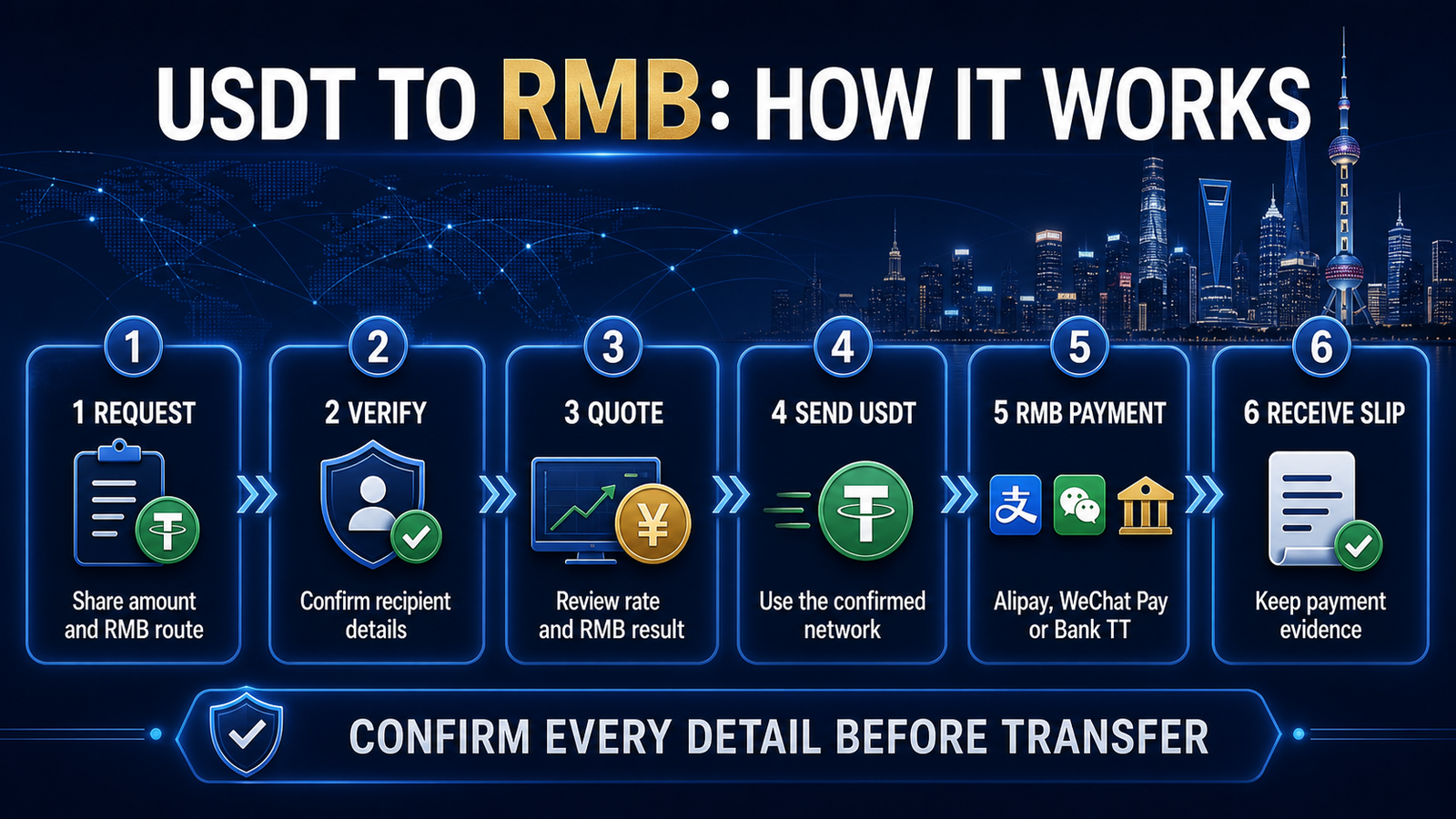
USDT-to-RMB settlement gives an international buyer a direct operational route from digital dollars to a confirmed renminbi payment for a Chinese recipient. Instead of asking the supplier to understand cryptocurrency, the buyer sends the agreed amount of USDT through the confirmed blockchain network. The settlement desk then completes the approved RMB payment through Alipay, WeChat Pay, or Chinese bank TT and provides a payment slip.
What does USDT to RMB mean?
USDT to RMB describes a settlement in which one party provides Tether USDt and another party arranges a corresponding payment in Chinese renminbi to an eligible recipient. The sender deals with USDT; the supplier or beneficiary receives RMB through the payment route agreed before the transfer.
USDT is a blockchain-based token intended to track the value of the US dollar. Tether issues it on several supported protocols, including TRON as a TRC20 token and Ethereum as an ERC20 token. RMB is the general name for the currency of the People’s Republic of China; CNY is commonly used as the onshore currency code. In practical supplier-payment conversation, people often say RMB when they mean the amount the Chinese recipient should receive.
The service is not a direct blockchain conversion performed inside Alipay, WeChat, or a Chinese bank account. Those recipients do not need to receive or handle USDT. There are two connected legs: an on-chain USDT transfer to the confirmed wallet and an off-chain RMB payment to the confirmed recipient. The settlement desk coordinates the bridge between them.
This distinction explains why the blockchain transaction hash is not the same as the RMB payment slip. The hash proves that a token transfer was recorded on a particular blockchain. The payment slip documents the separate RMB payment. A well-managed transaction preserves both records and connects them to the quote, beneficiary, invoice or purpose when applicable.
The real importer problem: payment friction, not merely currency conversion
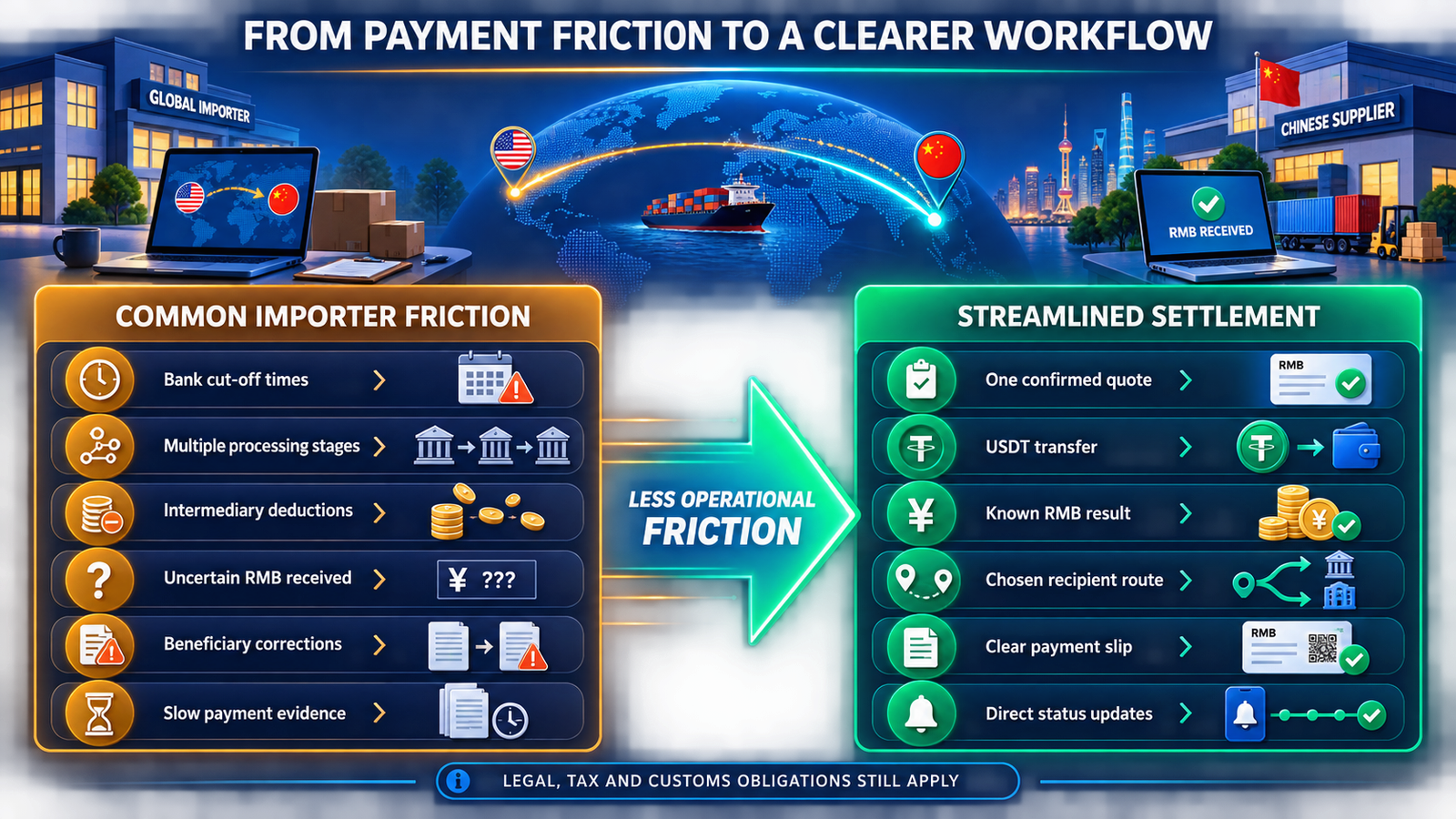
An importer can find a suitable factory, negotiate the price, approve the sample, and still lose valuable time at the payment stage. International bank payments are shaped by bank operating hours, compliance reviews, beneficiary formatting, correspondent relationships, currency conversion, local cut-off times, and the receiving bank’s own processing. Modern banking systems can be fast, and SWIFT reports major improvements in network-level speed, but an importer experiences the complete journey rather than the messaging network alone.
The delay often begins before a payment is released. The buyer may need to register a new beneficiary, explain the purpose, upload an invoice, wait for approval, confirm a phone call, or correct a field. The payment can then pass through several institutions. Even when it reaches the beneficiary bank quickly, local crediting, name checks, weekends, holidays, or account restrictions can affect when the supplier sees usable funds.
Cost is similarly fragmented. The sending bank may charge a transfer fee. One or more intermediaries may deduct charges. A foreign-exchange spread may be embedded in the conversion. The receiving bank may apply another fee. The importer may know the debited amount without knowing the precise RMB the supplier will receive. When a supplier insists on receiving a net amount, the buyer must absorb the uncertainty.
Payment evidence is another pain point. A factory may not release materials or begin production until it sees a credible payment slip. A bank instruction screen is not always proof that the payment was executed, and a SWIFT message may not mean the beneficiary has been credited. The buyer then spends time between bank support and supplier sales staff, translating status updates rather than moving the order forward.
USDT-funded RMB settlement addresses this operational gap. It turns the request into a defined sequence: identify the recipient route, confirm the beneficiary, obtain a quote with a known RMB result, send the correct USDT on the correct network, receive the RMB payment evidence, and have the recipient confirm. The value is not that paperwork disappears by magic. The value is that avoidable layers are removed and the remaining confirmations are organized before funds move.
Who is this settlement route designed for?
The route is primarily useful to international buyers who already hold USDT or can lawfully acquire it and who have a legitimate need to pay an eligible Chinese recipient. Typical users include small importers, e-commerce operators, sourcing agents, wholesalers, private-label brands, manufacturers purchasing components, and individuals buying goods or services from China.
It can be especially useful when the supplier prefers a domestic RMB route. Some smaller counterparties are comfortable receiving Alipay or WeChat Pay for eligible amounts. Established factories may require a corporate Chinese bank account. The buyer’s payment method should follow the recipient’s approved route, the commercial relationship, and the records needed for the transaction.
The route may also help buyers operating across difficult time zones or banking environments. A buyer in the United States may need to respond to a supplier while Asian banking hours are closing. A buyer in Russia, the Middle East, Africa, Latin America, or Europe may face different banking access, transfer fees, foreign-exchange controls, or provider availability. USDT offers a common digital settlement asset, but each user remains responsible for whether acquiring and using it is permitted in the relevant jurisdiction.
This service is not appropriate for someone attempting to hide the true payer, recipient, goods, source of funds, or transaction purpose. It is not a mechanism for evading taxes, customs duties, sanctions, reporting rules, or contractual obligations. A simpler payment workflow should support a legitimate business, not conceal one.
How USDT-to-RMB settlement works, step by step
Step 1: Define the RMB payment request
Begin with the amount the recipient should receive and the route it can accept. Do not begin by sending a random amount of USDT. The operational question is not merely how much USDT the buyer owns; it is what RMB result is required, who should receive it, through which rail, and by what deadline.
For a supplier purchase, collect the invoice or order reference, recipient name, account information, and any payment-purpose wording the supplier requires. If the recipient proposes a personal wallet for a business transaction, understand why and assess whether that route is suitable for your legal, tax, and accounting requirements.
Step 2: Confirm the recipient
Alipay and WeChat Pay require the correct identity and receipt capability. A Chinese bank TT requires accurate beneficiary and bank fields. A display name, QR code, telephone number, wallet identifier, bank-account name, and company name are not interchangeable. Confirm exactly which information the desk requires for the selected route.
If instructions changed since the previous order, verify them through a second trusted channel. Supplier impersonation and changed-payment-detail fraud can occur in email, messaging apps, and shared documents. Never rely only on a fresh contact, screenshot, or forwarded QR code.
Step 3: Request and review the quote
The quote should state the USDT amount, RMB result, route, recipient, network, applicable fee, and validity. It should also make clear when the guaranteed payment-slip period begins. Review the result before transferring. A rough public rate is useful for planning but is not the same as a confirmed transaction quote.
Step 4: Send USDT on the confirmed network
Copy the wallet address carefully and select the exact network stated in the instruction. USDT exists on multiple blockchains. A token symbol alone does not establish compatibility. A TRC20 withdrawal must go to a confirmed TRC20 receiving address; an ERC20 withdrawal must go through the confirmed Ethereum route. Send a test amount when instructed or whenever the risk justifies it.
After sending, preserve the transaction hash. The hash lets both sides verify the on-chain status independently. Do not share a screenshot as a substitute for the hash, and do not assume that an exchange’s internal status of complete is identical to the receiving desk’s required blockchain confirmation.
Step 5: RMB payment is executed
Once the correct USDT is confirmed and the recipient details remain usable, the RMB leg is processed through Alipay, WeChat Pay, or Chinese bank TT. Route-specific limits, recipient status, risk controls, and bank operating conditions can affect what information is needed, which is why the route is confirmed before USDT is sent.
Step 6: Receive and preserve the payment slip
ExtentExchange guarantees the wallet payment slip within 1-2 hours and the bank TT payment slip within 24 hours after the required confirmations. The slip should be matched to the amount and recipient. The recipient should then confirm receipt through a trusted contact.
The guarantee concerns issuance of the payment slip by the stated deadline. For bank TT, final credit visibility can also depend on the recipient bank’s posting and account controls. Keep the distinction clear in accounting and supplier communication.
Choosing the RMB recipient route
Alipay
Alipay can be practical for eligible personal or merchant recipients who actively use the platform and are able to receive the intended RMB payment. It is familiar, fast to confirm, and useful when a supplier or service provider does not require a formal bank TT. Eligibility should be checked before transfer because an active Alipay account is not automatically able to receive every amount or transaction type.
Confirm the recipient’s Alipay identity and any supporting detail requested by the desk. For a full platform explanation, see what Alipay is and how it works. For recipient preparation, use the USDT-to-Alipay details checklist.
WeChat Pay
WeChat Pay can serve recipients who use WeChat or Weixin as part of daily communication and commerce. As with Alipay, chat access does not prove payment-receipt eligibility. Confirm the actual recipient and route rather than sending money based on a contact profile or message alone.
Read the broad WeChat pillar guide for ecosystem context and the WeChat Pay recipient checklist for transaction preparation.
Chinese bank TT
Bank TT is usually more appropriate for larger corporate payments, formal supplier contracts, machinery, inventory, or transactions that require a conventional beneficiary bank record. The minimum for this route through ExtentExchange is 5,000 USDT. Beneficiary name, account number, bank name, branch, and payment-purpose details must be consistent.
A bank slip provides recognizable evidence for a commercial counterparty, but the recipient’s bank may still apply its own posting or review. Use the Chinese bank-account information checklist and the guide to payment-purpose and beneficiary fields.
| Route | Best suited to | Key preparation | Slip commitment |
|---|---|---|---|
| Alipay | Eligible wallet or merchant recipients | Confirm identity and receipt capability | 1-2 hours |
| WeChat Pay | Eligible recipients operating in the WeChat ecosystem | Confirm account and transfer route | 1-2 hours |
| Chinese bank TT | Larger or formal supplier payments | Complete beneficiary and bank fields | Within 24 hours |
Confirmed fees, minimums, and payment-slip guarantees
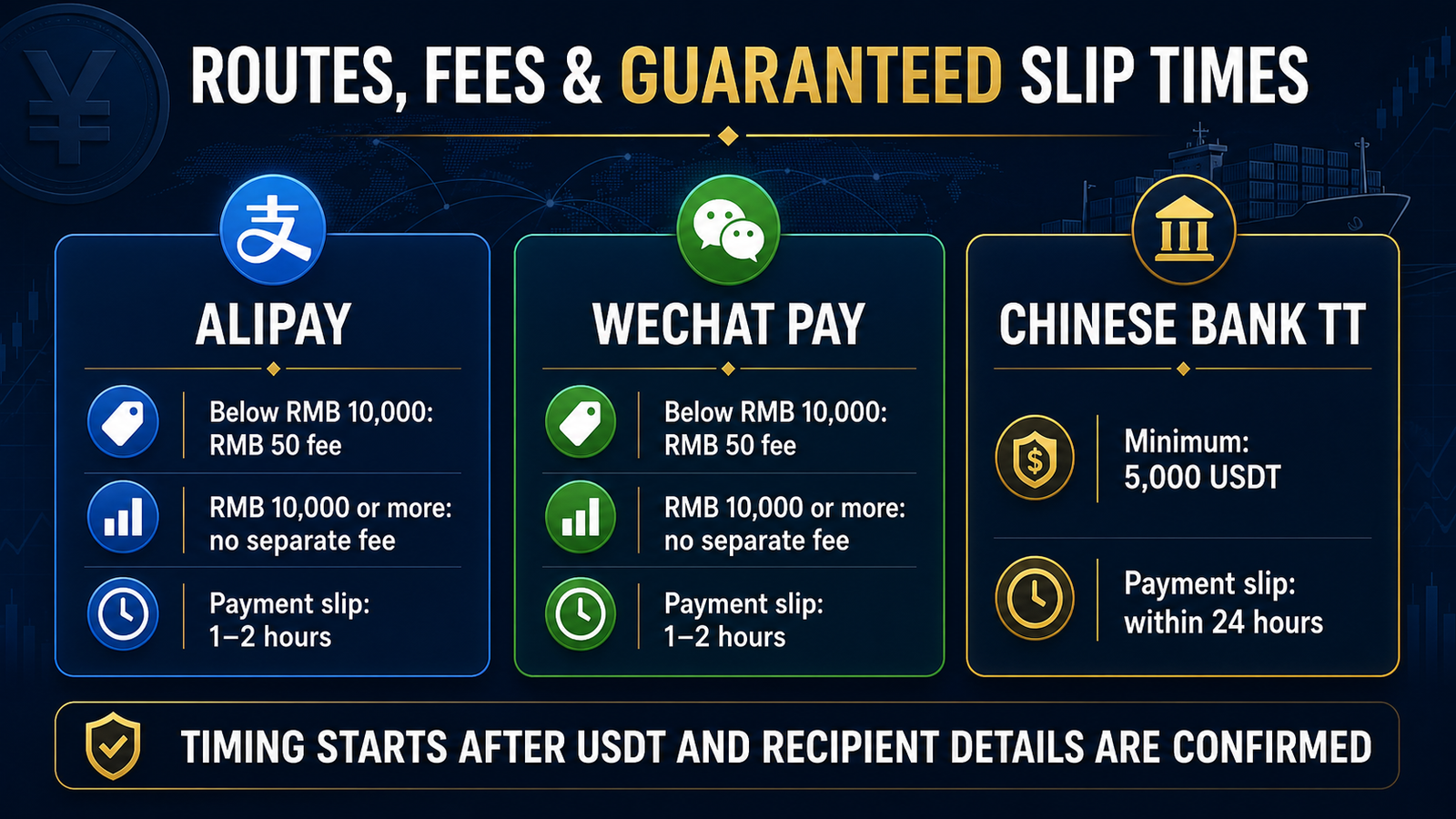
Pricing should be simple enough for the buyer to calculate before committing. For Alipay and WeChat Pay transactions below RMB 10,000, ExtentExchange charges RMB 50. For wallet transactions of RMB 10,000 or more, there is no separate service fee. The economics are reflected in the confirmed conversion terms presented before transfer.
Chinese bank TT has a minimum size of 5,000 USDT. The minimum reflects the operational work and banking route involved. Buyers with a smaller requirement should ask whether an eligible wallet route is suitable rather than splitting or disguising a transaction.
The Alipay and WeChat Pay payment-slip guarantee is 1-2 hours. The bank TT payment-slip guarantee is within 24 hours. These periods begin only after the correct USDT has been received or confirmed as required, the quote remains valid, and complete usable recipient information has been supplied. A delay caused by a sender using the wrong network or by an invalid recipient cannot logically begin the settlement clock.
Understanding the conversion quote
A good quote removes ambiguity. It should allow the buyer to answer five questions immediately: How much USDT will I send? How much RMB will the recipient receive? Which route will be used? How long is the quote valid? Is any separate fee applicable?
The quoted rate can differ from a public foreign-exchange midpoint because the service involves more than displaying USD/CNY. It includes liquidity, the digital-asset market, network movement, route availability, transaction size, execution risk, and the operational cost of arranging the RMB leg. The meaningful comparison is the complete result, not an isolated screen rate that cannot deliver RMB to the chosen recipient.
Rate movement creates a timing issue. A quote cannot normally remain open forever while the market changes. Confirm the validity window and send only while it remains active. If it expires, request a fresh quote rather than assuming the earlier RMB result still applies. The guide to indicative and confirmed rates explains this difference, while the rate and quote methodology describes the site’s planning information.
Never infer the final result by multiplying a search-engine currency rate by the USDT amount. USDT may trade slightly above or below one dollar on a secondary market, network and provider fees may affect acquisition, and the RMB settlement quote is a distinct commercial offer. Compare the total cost from obtaining USDT through confirmed RMB receipt.
TRC20, ERC20, and why the network matters
Tether supports USDt on multiple blockchain protocols. TRC20 refers to the token implementation on TRON, while ERC20 refers to the fungible-token standard used on Ethereum. A wallet or exchange can display the same USDT symbol for both, but the underlying networks and addresses are not a casual choice.
TRC20 is commonly used for settlement because it can offer practical transfer costs and broad exchange support. ERC20 remains widely supported and operates through Ethereum, where transaction fees are paid in ETH and can vary with network demand. Neither route should be selected from habit. Use the network specified for the current transaction.
A wrong-network transfer may not appear in the expected receiving system and can be difficult or impossible to recover. Before approving a withdrawal, compare the first and last characters of the address, confirm the network label, review the amount, and check any exchange warning. Clipboard malware can replace an address after it is copied, so visual verification matters.
Once submitted, public blockchain transfers are generally not reversible through a bank-style recall. That finality is useful for rapid settlement but places responsibility on the sender. Read the detailed TRC20 versus ERC20 guide and the wallet, network, and quote verification checklist before sending.
Preparing the recipient correctly
Most preventable settlement problems begin with recipient data. Importers often receive payment instructions through a salesperson who is not the account owner. A supplier may send a QR image without the legal or verified name. A bank beneficiary may use the factory’s Chinese entity while the invoice shows an export company. These situations require clarification before the USDT transfer.
Ask the supplier which entity is selling the goods, which entity will receive payment, and why they differ if they do. For bank TT, confirm the beneficiary name character for character. For wallet routes, obtain the recipient information requested by the desk and have the supplier confirm it. Avoid relying on a cropped screenshot that hides account context.
If the supplier changes instructions, pause. Verify the change through a previously known telephone number, company-domain email, or another established manager. Do not let urgency override verification. A fraudster may know the real order amount and conversation details after compromising an account.
Recipient capacity matters as much as identity. An account may be genuine but unable to receive the proposed payment because of platform limits, risk controls, account status, or transaction type. Confirm eligibility first. If a recipient cannot receive RMB, do not keep retrying; use the guidance for an Alipay or WeChat Pay recipient failure.
Documentation and transaction review
ExtentExchange aims to keep the workflow proportionate. Invoices or other supporting documents are requested when the transaction or review requires them, and the owner reports that this is uncommon in ordinary eligible cases. This does not mean documentation is forbidden or that the service promises anonymous settlement.
A reasonable request may include an invoice, order record, payer identity, recipient explanation, source-of-funds information, or clarification of the goods and purpose. The exact need can vary with amount, pattern, jurisdiction, recipient, risk signal, or legal obligation. Providing a clear document once can be faster than attempting to route around a legitimate question.
Importers should maintain records even when nothing is requested by the desk. A business still needs evidence for bookkeeping, inventory costing, tax, customs, ownership disputes, warranty claims, and supplier reconciliation. A simplified payment process does not erase the commercial transaction behind it.
Customers remain responsible for applicable taxes, import duties, declarations, sanctions, exchange controls, and business regulations. ExtentExchange can simplify the settlement workflow; it cannot determine every customer’s legal obligations in every country. Obtain professional advice when the transaction raises legal or tax uncertainty.
International buyer scenarios
A United States importer paying a small supplier
A US-based e-commerce seller orders packaging from a supplier that prefers Alipay. A bank wire may be disproportionate for the amount, and card acceptance may be unavailable. The buyer requests an RMB result, verifies the Alipay recipient, reviews the quote, sends the confirmed USDT, and receives the payment slip within the guaranteed 1-2-hour period. The buyer keeps the invoice, quote, transaction hash, and payment slip for records.
A Russian buyer with limited banking options
A buyer may have difficulty finding a practical cross-border route because provider access and sanctions rules vary. USDT can be technically transferable, but the buyer must still ensure that the transaction, parties, goods, and service use are permitted. If accepted, the same operational workflow applies: verified recipient, confirmed quote, correct network, payment slip, and recipient confirmation.
A Middle Eastern wholesaler paying a factory
A wholesaler purchasing a larger production batch may prefer Chinese bank TT because the factory needs formal bank evidence. If the transaction meets the 5,000-USDT minimum, the beneficiary data is checked before funding. The desk guarantees the bank payment slip within 24 hours after confirmation, helping the buyer give the factory a defined payment-evidence deadline.
An African importer managing foreign-exchange friction
An importer may face local bank limits, expensive dollar access, or uncertain correspondent deductions. If the importer can lawfully acquire USDT, a confirmed RMB quote provides a clearer supplier result. The buyer should compare the complete acquisition and settlement cost, not assume that USDT is automatically cheaper in every local market.
A European brand paying multiple China partners
A brand may work with a factory, inspection company, packaging provider, and freight agent. Each recipient can require a different rail. The business should maintain separate requests and records rather than combining unrelated obligations into an unclear payment. A streamlined service is most valuable when operational discipline remains strong.
What payment evidence should the buyer keep?
Commercial record
Keep the purchase order, invoice, supplier confirmation, goods description, and payment milestone. These explain why the payment existed.
Quote record
Save the confirmed USDT amount, RMB result, recipient route, fee, network, and validity period.
Blockchain record
Preserve the sending wallet or exchange record and transaction hash. Verify it through the appropriate block explorer.
RMB record
Keep the payment slip and the recipient’s confirmation. For a bank payment, preserve the beneficiary and reference details.
These records create an audit trail across both legs of the transaction. If an amount, recipient, or date is questioned later, the buyer can reconstruct what was requested and what was completed. Screenshots are useful, but original PDFs, invoices, hashes, and exported transaction records are stronger.
Do not treat a payment slip alone as proof that the supplier shipped goods or fulfilled the contract. Payment execution and commercial performance are separate risks. Inspection, quality control, shipping documents, and contractual remedies remain part of procurement management.
Main risks and practical safeguards
Wrong blockchain network
Confirm the network every time. Do not reuse an old address or assume that all USDT routes are interchangeable.
Wrong or impersonated recipient
Verify the beneficiary independently, especially after any change. Display names and profile photographs are not identity controls.
Expired or misunderstood quote
Send only against a current confirmed quote. Check whether the request is defined by USDT sent or RMB received.
Supplier-performance risk
USDT-to-RMB settlement solves payment execution, not product quality or delivery. Use contracts, inspection, milestones, and trusted sourcing procedures.
Regulatory and tax risk
Check the rules applicable to the sender, recipient, goods, and source of funds. Never describe or structure a transaction to conceal its real purpose.
Account or platform restrictions
An Alipay, WeChat Pay, exchange, wallet, or bank account can be restricted. Confirm eligibility and keep an alternative route for urgent procurement.
Credential and phishing risk
Use official contacts, secure devices, strong authentication, and address verification. Never disclose a password, SMS code, seed phrase, or private key.
Final pre-transfer checklist
- The supplier and recipient have been independently verified.
- The recipient can accept the selected RMB route.
- The confirmed quote states the USDT amount and RMB result.
- The quote remains valid.
- The wallet and network match the current instruction.
- Any applicable RMB 50 fee is understood.
- The buyer knows when the payment-slip guarantee begins.
- The transaction is lawful and accurately documented.
- The transaction hash and RMB payment slip will be retained.
USDT-funded RMB settlement versus a conventional bank wire
A fair comparison recognizes that bank wires are valuable. They are familiar to accountants, suitable for large formal invoices, and supported by regulated financial institutions. SWIFT and participating banks have improved tracking and speed considerably. The problem is that the experience is inconsistent across senders, countries, correspondent routes, and receiving banks.
USDT-funded settlement offers a different structure. The buyer transfers a digital asset that can move without bank cut-off times, while the desk arranges the local RMB payment. The buyer receives a confirmed RMB result and a defined payment-slip deadline. This can reduce operational uncertainty for a supplier waiting to see evidence.
| Question | Conventional cross-border bank wire | USDT-funded RMB settlement |
|---|---|---|
| Funding asset | Fiat through a bank account | USDT on the confirmed blockchain |
| Operating hours | Can depend on bank cut-offs and business days | Blockchain transfer can be initiated continuously; RMB processing follows accepted service terms |
| Final RMB visibility | Can depend on FX and deductions | Confirmed RMB result stated in the quote |
| Recipient routes | Primarily beneficiary bank account | Eligible Alipay, WeChat Pay, or Chinese bank TT |
| Evidence deadline | Depends on bank and route | Guaranteed slip period after confirmation |
| Reversibility | Recall may be requested but is not guaranteed | Blockchain transfer is generally irreversible; verification before sending is critical |
| Best use | Traditional formal banking workflow | Buyers seeking a clear USDT-to-RMB operational route |
The right method depends on the transaction. A large factory invoice with strict accounting requirements may favor bank TT. A smaller eligible recipient may prefer Alipay. An importer holding USDT may value a direct settlement route. The decision should balance speed, documentation, recipient preference, cost, legal suitability, and risk.
Frequently asked questions
What is the minimum USDT-to-RMB amount?
The confirmed special minimum in this guide applies to Chinese bank TT: 5,000 USDT. Wallet-route eligibility is assessed by the requested RMB amount and current service terms.
What fee applies to Alipay or WeChat Pay?
Below RMB 10,000, the fee is RMB 50. At RMB 10,000 or more, there is no separate service fee.
How fast is the Alipay or WeChat Pay payment?
ExtentExchange guarantees the payment slip within 1-2 hours after the correct USDT and usable recipient details are confirmed under the accepted quote.
How fast is Chinese bank TT?
ExtentExchange guarantees the bank TT payment slip within 24 hours after confirmation. The receiving bank’s final posting can remain subject to its own processing.
Does the supplier need a crypto wallet?
No. The buyer sends USDT to the confirmed desk wallet, while the supplier receives RMB through the agreed eligible route.
Which USDT network should I use?
Use only the network confirmed for the transaction. Do not choose TRC20 or ERC20 based on the token symbol alone.
Will I be asked for an invoice?
An invoice or supporting information can be requested if the transaction review requires it. The owner reports that this occurs infrequently in ordinary eligible transactions, but no transaction should be represented as exempt from lawful review.
Can I use the service to avoid tax or customs duties?
No. Customers remain responsible for applicable tax, customs, reporting, sanctions, and legal obligations. A payment method does not change the underlying commercial responsibility.
Is the public rate the rate I will receive?
No. Public rates are planning information. The confirmed quote controls the USDT amount, RMB result, route, and validity for the actual request.
What happens if I send to the wrong network?
Recovery may be difficult or impossible. Contact support immediately with the transaction hash, but prevention through network and address verification is essential.
Can I pay a personal Alipay or WeChat account for a business invoice?
Only use a route that is eligible, accurately identified, and suitable for your legal and accounting circumstances. Clarify any difference between the contracting supplier and payment recipient.
What proof will I receive?
You should retain the quote, blockchain transaction hash, RMB payment slip, recipient details, and recipient confirmation, together with the commercial documents.
The bottom line
The strongest reason to use USDT-to-RMB settlement is operational clarity. An international buyer should not have to spend days guessing which bank holds a payment, how much an intermediary deducted, or when a supplier will receive usable proof. With the route and recipient confirmed in advance, the transaction becomes a defined exchange of value: the buyer sends the agreed USDT and the eligible Chinese recipient receives the agreed RMB payment through Alipay, WeChat Pay, or bank TT.
ExtentExchange’s role is to remove unnecessary friction while preserving the confirmations that make a payment dependable. Wallet transactions below RMB 10,000 carry an RMB 50 fee; wallet transactions at or above that level have no separate fee. Bank TT starts at 5,000 USDT. The payment-slip commitment is 1-2 hours for Alipay and WeChat Pay and within 24 hours for bank TT after the correct funds and recipient information are confirmed.
Speed should never replace accuracy. Verify the recipient, quote, wallet, network, amount, and legal purpose before sending. When those fundamentals are correct, USDT-funded RMB settlement can give an importer what the procurement process needs most: a known result, a clear deadline, and evidence the supplier can act upon.
Primary sources and editorial basis
- Tether: how Tether tokens work and reserve information
- Tether: supported protocols and integration guidance
- TRON developer documentation: TRC20 interactions
- Ethereum.org: ERC20 token standard
- Ethereum.org: gas and transaction fees
- SWIFT: cross-border payment transparency and processing initiative
ExtentExchange-specific fees, minimums, and payment-slip guarantees in this article were confirmed by the site owner on 30 August 2026. Eligibility and operational details should be reconfirmed before each transaction.