
The practical answer: the right way to pay a Chinese supplier depends on the order value, the stage of the commercial relationship, the recipient account and the protection the buyer needs. Bank TT and platform escrow remain useful for formal or high-value orders. Alipay and WeChat Pay can suit eligible wallet recipients. An operational USDT-to-RMB settlement route can help an international buyer who already holds USDT and needs a verified Chinese recipient paid in RMB without waiting through a conventional cross-border banking chain.
This guide treats payment as a procurement decision, not a shortcut around law, tax, customs or supplier due diligence. The objective is to remove avoidable delay and friction while keeping the invoice, purchase order, recipient identity, quote, transaction record and payment slip aligned.
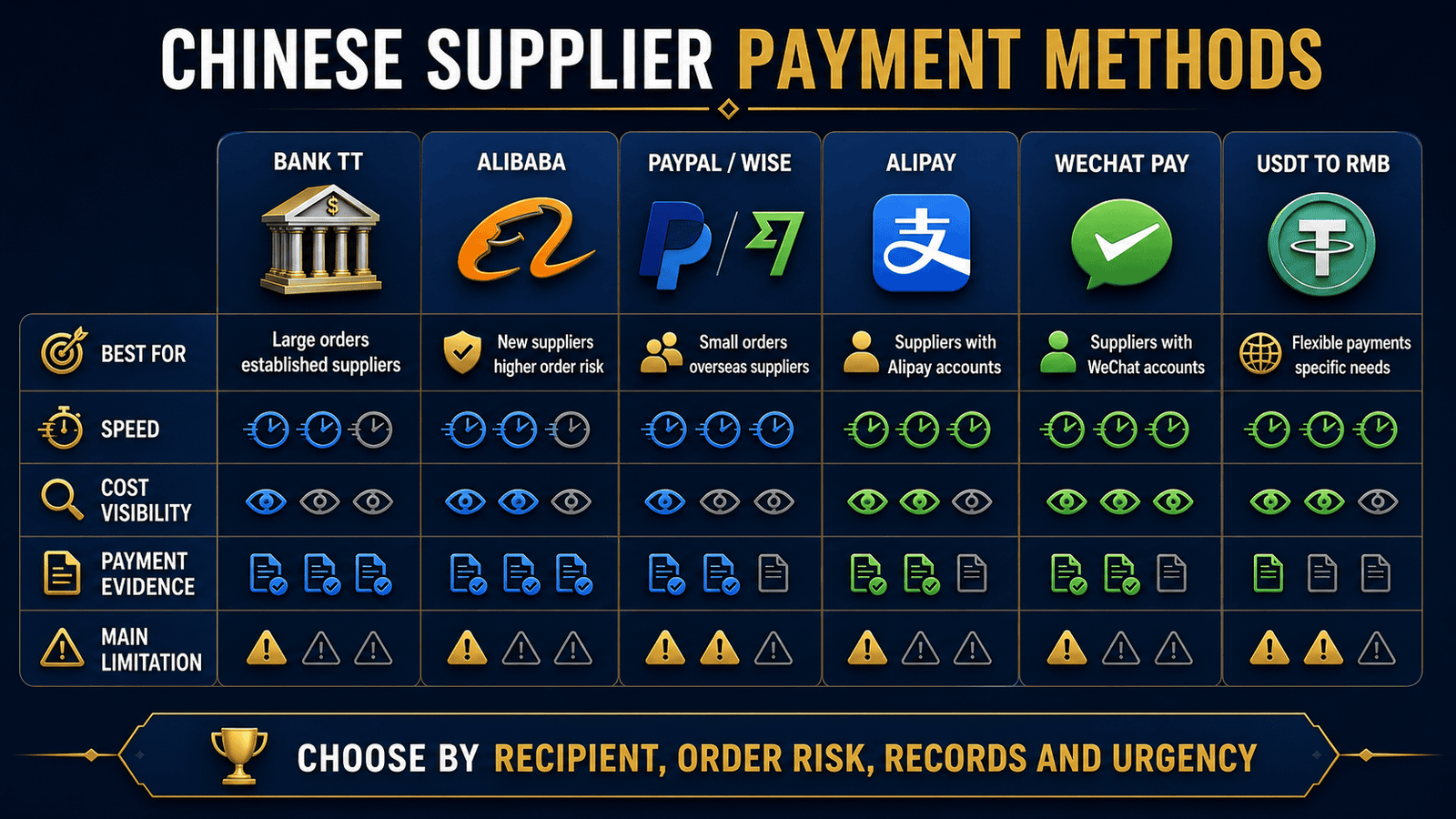
- The Comparison Framework
- Method 1: Traditional Bank Wire Transfer (TT)
- Method 2: Letter of Credit (LC)
- Method 3: PayPal
- Method 4: Wise (formerly TransferWise)
- Method 5: USDT OTC Settlement (Private Desk)
- The Cost of Delays: What Traditional Comparisons Ignore
- Side-by-Side Summary
- Making the Right Choice for Your Situation
Choosing how to pay a Chinese supplier is one of the most consequential operational decisions for any international buyer sourcing from China — yet most procurement professionals compare payment methods using only the metrics banks and payment platforms want them to use: transaction fees and exchange rates.
This narrow framing hides the full cost of each method, including delays that kill production schedules, documentation that fails at customs, fraud exposure that traditional buyers underestimate, and the invisible administrative burden of tracking dozens of wire confirmations across multiple banking systems.
This comparison examines five widely used payment methods for China procurement on metrics that actually matter to your bottom line: total landed cost (including hidden fees), timeline reliability, fraud protection, documentation quality, scalability, and operational complexity. The goal is not to declare a winner before reading the data — it is to give you an honest framework for choosing based on your specific situation.
The Comparison Framework
| Evaluation Criterion | Why It Matters |
|---|---|
| Total landed cost (fees + FX + hidden costs) | Transaction fees are visible; hidden costs compound silently |
| Timeline reliability and predictability | Production deadlines cannot be renegotiated when payments fail |
| Fraud protection | Supplier account change scams cost the industry billions annually |
| Documentation quality | Auditors require proof; customs requires accuracy |
| Scalability | What works for 5 payments/month breaks at 50 |
| Operational complexity | Time spent managing payments is time not spent on procurement strategy |
Method 1: Traditional Bank Wire Transfer (TT)
Cost Structure
| Cost Component | Typical Range | Who Charges It |
|---|---|---|
| Outgoing wire fee | $25–50 per transaction | Your sending bank |
| Incoming wire fee | $10–30 per transaction | Supplier’s Chinese bank |
| Intermediary bank fees | $5–25 per hop | Corridor-dependent banks |
| FX spread | 0.3%–1.5% | Your bank’s treasury desk |
Total cost on a $10,000 payment: $60–$150+ depending on your banking relationships, the currency corridor, and whether intermediary banks intervene in the routing.
Timeline
- Domestic (within US): 1–3 business days
- International to China: 2–5 business days
- Extended delays possible when intermediary banks flag transactions or Chinese banks perform enhanced due diligence — particularly for payments with crypto funding sources
Fraud Protection
Minimal. Wire transfers are irreversible once cleared. You send funds to whatever account number the supplier provides — if that account has been compromised (supplier email hacked, invoice modified), the money is gone. Supplier account change fraud is one of the most common procurement threats and wire transfers offer no defense.
Documentation
Standardized banking documentation by default: SWIFT confirmations, bank statements, wire receipts. Strong audit trail but limited commercial detail — the bank records the transfer, not what it was for.
Scalability
Scales linearly with cost. Twenty payments per month at an average of $5,000 each = potentially $1,000–$1,600 in wire fees alone, plus invisible labor costs from tracking TXIDs and reconciling with invoices.
Verdict
TT remains the default for large transactions where LC alternatives are impractical or regulatory requirements demand bank-mediated transfers. For routine procurement payments under $25,000, the cost and timeline inefficiencies become substantial relative to alternatives.
Method 2: Letter of Credit (LC)
Cost Structure
| Cost Component | Typical Range |
|---|---|
| LC issuance fee | 0.1%–0.75% of transaction value |
| Advising/confirmation fees | $100–500 per transaction |
| Documentation compliance charges | $50–200 per amendment |
Total cost on a $50,000 LC: $450–$2,000+ depending on complexity and terms.
Timeline
- LC setup: 3–7 business days (opening bank processes)
- Payment after document presentation: 5–10 business days
- Total from order to payment completion: 2–4 weeks minimum
Fraud Protection
Strongest of all methods. LCs hold funds in escrow until documents prove the supplier fulfilled their obligations (shipping proof, inspection certificates, bills of lading). Neither party can access funds unilaterally. This is why LCs remain standard for first-time high-value transactions with unfamiliar suppliers.
Documentation
Most comprehensive of any payment method — but also the most administratively intensive. Requires commercial invoices, packing lists, bills of lading, inspection certificates, and often multiple amendments as order details change. A single document error can delay payment by weeks.
Scalability
Poor. LCs make sense for large individual transactions ($25,000+) where the escrow protection justifies the cost and timeline. They become prohibitively expensive and slow for recurring smaller payments. The documentation burden does not scale with transaction volume.
Verdict
LCs are essential risk management tools for specific use cases — first-time suppliers, high-value orders, transactions in jurisdictions where enforceability is uncertain. They are impractical as a general payment method for most procurement workflows due to timeline and cost constraints.
Method 3: PayPal
Cost Structure
| Cost Component | Typical Range |
|---|---|
| Platform fee | 2%–4% + fixed fee per transaction |
| FX spread | 3%–4% above mid-market rate |
| Withdrawal fees (supplier side) | Variable, often $10–30 |
Total cost on a $5,000 payment: ~$200–$350 — dominated by the FX spread, which is among the widest of any digital payment platform.
Timeline
- Recipient notification: Minutes
- Supplier withdrawal to bank account: 1–3 business days
- Dispute resolution: 10–30 days if invoked
Fraud Protection
Moderate. PayPal’s buyer protection covers commercial transactions but has significant limitations for B2B payments, particularly for high-value orders. Chargeback mechanisms exist but are less reliable for international commerce where enforcement varies by jurisdiction. Many Chinese suppliers avoid PayPal because withdrawal to Chinese bank accounts carries restrictions that reduce their actual receipt of funds.
Documentation
Transaction receipts and confirmation emails — functional but less detailed than banking records. Insufficient as primary documentation for some auditors or customs authorities who require formal bank-issued confirmations.
Scalability
Worse at scale. The percentage-based fee structure means costs grow linearly with transaction size, and FX spreads on larger amounts become substantial. Many suppliers cap PayPal transactions due to platform limitations, making it unsuitable for orders exceeding their limits.
Verdict
PayPal works for small, one-off payments where convenience outweighs cost. Above $1,000 per transaction, the cumulative fees — especially the FX spread — make it economically inefficient for recurring procurement workflows. Most Chinese factory suppliers also do not maintain active PayPal accounts, limiting its applicability.
Method 4: Wise (formerly TransferWise)
Cost Structure
| Cost Component | Typical Range |
|---|---|
| Transparent fee | 0.3%–1% depending on amount |
| FX spread | Embedded in rate; typically 0.05%–0.4% above mid-market |
| China direct coverage | Limited — not all currencies route directly |
Total cost on a $10,000 payment: ~$40–$80 — among the most transparent of digital platforms, but limited by geographic constraints.
Timeline
- Typical to Chinese bank: Same day to next business day
- Indirect routing (via intermediary): 2–4 additional days
- Coverage gaps for certain corridors introduce unpredictable delays
Fraud Protection
Limited. Wise verifies recipient accounts before disbursement, which prevents payment to fraudulent accounts — but once funds leave the platform, reversibility depends on how quickly the supplier withdraws them. Not equivalent to LC escrow protection. Some buyers use Wise’s tracking features as a partial substitute for buyer protection.
Documentation
Good transparency on FX rates and fee breakdowns. Transaction records are clear and detailed, though less comprehensive than formal banking documentation for audit purposes. China coverage limitations mean some payments cannot receive direct documentation from Wise.
Scalability
Moderate. Transparent pricing helps with budgeting at scale, but limited direct China coverage means some corridors still require intermediary routing — adding fees, delays, and documentation complexity that undermine Wise’s transparency advantage. For buyers with diverse supplier locations across China, routing consistency is not guaranteed.
Verdict
Wise offers excellent transparency for corridors it supports directly. Its geographic limitations for China-bound payments mean it cannot serve as a comprehensive payment method for buyers sourcing from factories across multiple provinces — some routes still require traditional banking backstops.
Method 5: USDT OTC Settlement (Private Desk)
Cost Structure
| Cost Component | Typical Range |
|---|---|
| Network fee (USDT deposit) | $0–5 typically (TRC20); ERC20 can be higher ($5–30+ depending on gas prices) |
| OTC desk spread | Determined at quote time; confirmed in writing before transfer |
| Settlement to supplier | Included in spread — no additional fees |
Total cost: network fee + known desk spread. The critical distinction from all other methods is that the total cost is confirmed and fixed before you commit any funds, not subject to unpredictable intermediary charges or floating FX spreads.
Timeline
- Desk review: Typically 1–3 hours for first-time requests; less for repeat customers
- USDT on-chain confirmation: Minutes (TRC20) to ~60 minutes (ERC20)
- RMB disbursement to supplier: 30 minutes to 2 hours after confirmation
- Total from request to supplier receipt: Often same business day
Unlike traditional banking, settlement timelines are determined by market conditions and desk capacity — not banking hours, intermediary bank schedules, or compliance queues at correspondent banks. Desk operators confirm your exact timeline during the quote.
Fraud Protection
Desk-side verification before disbursement. The private desk verifies both the sender’s identity and the recipient’s payment account eligibility before settling any funds. This pre-settlement verification replaces the need for post-transaction dispute mechanisms — because fraudulent or incorrect recipients are identified and blocked before any RMB is disbursed.
This model addresses supplier account change fraud (the single most common procurement threat) more effectively than traditional banking, where you send directly to whatever account the supplier provides with no intermediary checkpoint. With USDT OTC settlement, your funds go to the desk first; the desk only disburses to a verified recipient. The separation of flows creates an additional fraud layer that traditional payments lack entirely.
Documentation
Written quote confirmation, blockchain TXID (immutable proof of timing and amount), desk-side compliance records, and settlement completion confirmation. For buyers comfortable with crypto documentation, this provides a more complete audit trail than bank wire receipts because every step — rate confirmation, recipient verification, settlement — is documented in writing. For traditional accounting teams, the lack of standardized banking documentation may require supplementary explanation during audits.
Scalability
The strongest scalability of any method. Once your profile is established (identity verified, compliance complete), subsequent settlements become faster and more predictable. The desk already knows you, has validated your funding sources, and understands your payment patterns — each transaction processes with diminishing review time. For buyers processing 10+ payments per month to Chinese suppliers, the operational advantage compounds: fewer wire fees accumulating across settlements, less time chasing bank confirmations, reduced fraud exposure through desk-side verification on every transaction.
The Cost of Delays: What Traditional Comparisons Ignore
Every payment method comparison focuses on explicit costs (fees, FX spreads). This misses the largest variable in procurement payments: the cost of delays, which traditional banking introduces systematically and USDT settlement eliminates for most use cases.
| Delay Scenario | Traditional TT Impact | USDT Settlement Impact |
|---|---|---|
| Deposit payment delayed 3 days | Production starts 3 days late; shipping pushed; potential stockout | Same-day — production starts when it should |
| Balance payment arrives after QC passes | Factory cannot release goods; storage costs accrue; buyer pays expedited freight to recover timeline | Payment confirmed hours before balance due; goods release on schedule |
| Bank rejects/reviews wire (compliance) | 5–10 business days of uncertainty; production halted; possible order cancellation | Desk pre-verifies recipient eligibility — no surprise rejections |
| Weekend/holiday timing | Extends settlement by 2–3 additional days | Blockchain operates continuously; desk settlement unaffected |
For Amazon FBA sellers, these delays translate directly into inventory gaps, suppressed rankings, and lost revenue. For contract manufacturers, they cascade into missed shipping windows, dock demurrage charges, and production slot losses that cost thousands per incident. Traditional payment guides never quantify this because the economics of banking infrastructure are opaque by design.
Side-by-Side Summary
| Criterion | TT Bank Wire | Letter of Credit | PayPal | Wise | USDT OTC Settlement |
|---|---|---|---|---|---|
| Cost on $10,000 | $60–$150+ | $450–$2,000+ (LCs typically $25K+) | $200–$350 | $40–$80 | Network fee + known spread |
| Timeline | 2–5 business days | 2–4 weeks | Minutes to 3 days | Same day to 4 days | Often same business day |
| Fraud protection | Minimal (irreversible) | Strongest (escrow) | Moderate (disputes) | Limited | Strong (pre-verification) |
| Documentation | Excellent (standardized) | Most comprehensive | Basic | Good | Complete (digital records) |
| Scalability | Poor (costs compound) | Poor (complexity grows) | Poor (fees scale linearly) | Moderate (coverage gaps) | Strongest (diminishing review) |
| Operational complexity | High (TXIDs, wires) | Very high (documents) | Low | Low | Low-to-moderate (desk process) |
Making the Right Choice for Your Situation
No single payment method dominates across all scenarios. The choice depends on your transaction profile:
Choose Letter of Credit when: First-time supplier relationship with $25,000+ orders where escrow protection justifies the cost and timeline. No other method provides equivalent risk mitigation for high-value unfamiliar transactions.
Choose TT Bank Wire when: Regulatory requirements demand bank-mediated transfers; your company’s accounting team requires SWIFT documentation exclusively; or the transaction size and corridor make LC impractical but banking relationships provide favorable rates.
Choose PayPal when: Making a small one-off payment ($50–$500) to a supplier who only accepts PayPal, where convenience outweighs the cost premium.
Choose Wise when: Your specific supplier corridor is covered by Wise’s direct routing, transparency matters to your accounting team, and transaction frequency justifies maintaining an additional platform relationship.
Choose USDT OTC Settlement when: You process 5+ payments per month to Chinese suppliers; timeline predictability affects production deadlines or supplier relationships; total landed cost matters significantly to margins; you value knowing your exact rate before transferring funds; and fraud protection through pre-recipient verification is more valuable than post-transaction dispute mechanisms.
For procurement professionals sourcing from China on a recurring basis, the convergence of lower costs, faster timelines, strong fraud protection, and superior scalability at scale makes USDT OTC settlement through a private desk the most economically rational choice for the majority of use cases — even when it is not the most familiar one. Familiarity is a learned advantage; operational superiority is structural.
Fact-check scope and practical limits
This article was reviewed as an educational planning guide on July 26, 2026. Provider rules, network conditions, payment-route availability, fees, rates, limits, and compliance requirements can change. Any numerical examples in this article are planning illustrations, not guaranteed transaction terms. Confirm current transaction-specific terms before transferring funds.
Frequently asked questions
What should be confirmed before relying on this guidance?
Confirm the commercial purpose, parties, recipient, route, amount, wallet, network, executable rate, expected RMB, validity window, timing limitations, and required records for the specific transaction.
Are the fees, rates, limits, and timelines in this article guaranteed?
No. Numerical examples are illustrative unless a current primary source or an ExtentExchange transaction-specific quote states otherwise.
Does an on-chain confirmation prove the RMB recipient was paid?
No. It proves a blockchain event. RMB-side delivery and the recipient's reconciliation are separate checkpoints.
Check the current indicative rate information, review the transaction requirements, and confirm the supplier, RMB recipient, payment route, and quote with the desk before sending.
Where ExtentExchange fits into a Chinese supplier payment
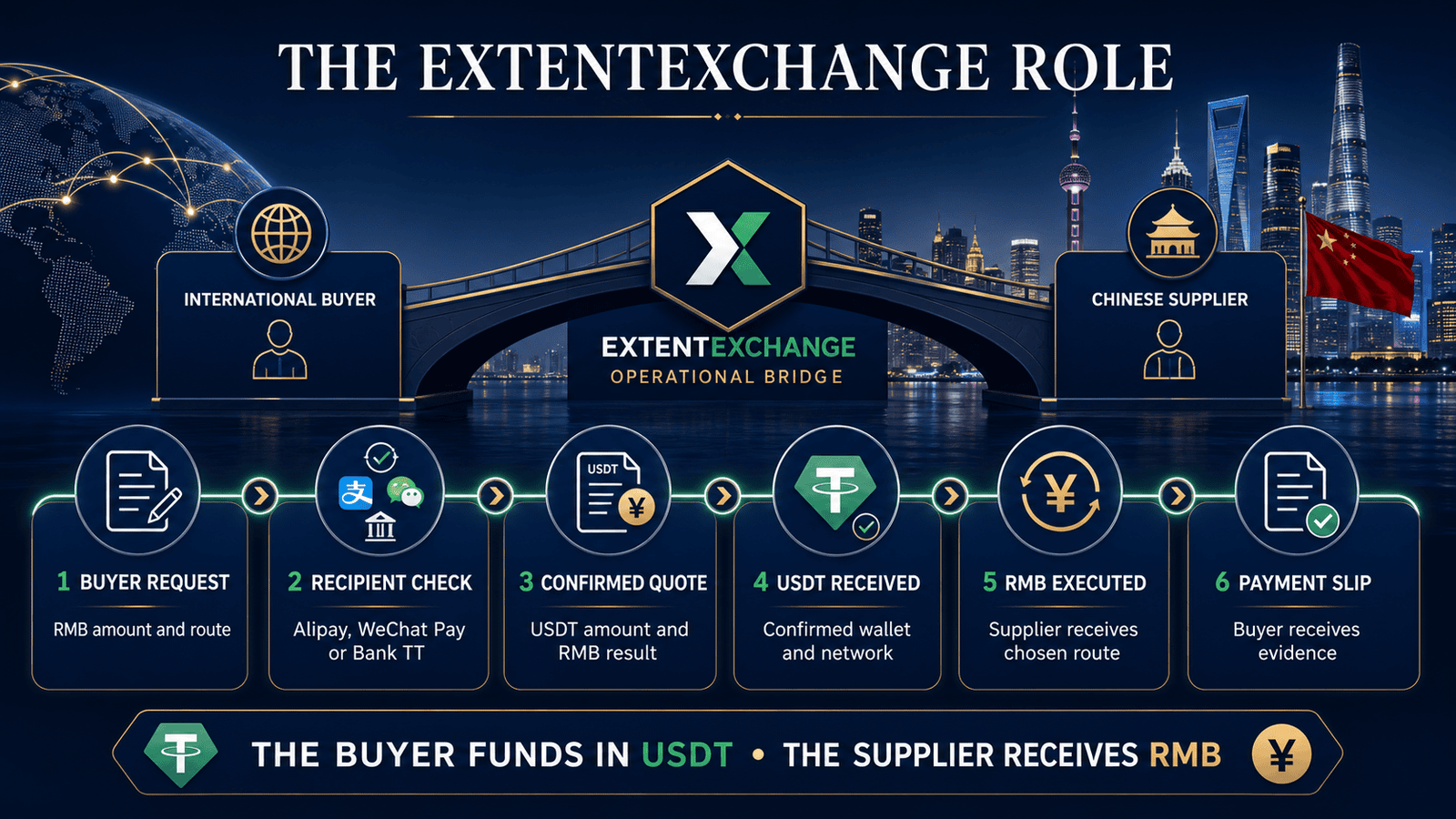
ExtentExchange is an operational bridge between an international buyer who can fund in USDT and an eligible Chinese recipient who needs RMB. Its role is narrow and practical: confirm the requested route, check the recipient information, provide a quote, receive the agreed USDT on the confirmed network, arrange the RMB payment and return the payment slip. It is not the seller, freight forwarder, customs broker, tax adviser or quality inspector. The buyer remains responsible for deciding whether the supplier and underlying purchase are genuine and lawful.
This distinction matters. Importers often describe the problem as a foreign-exchange problem, but the deeper difficulty is coordination. A supplier may insist on domestic RMB, production may not start until a deposit is visible, a bank may require several working days, and mistakes in a beneficiary name or wallet recipient can interrupt the order. ExtentExchange concentrates on the settlement leg so that the buyer and supplier can continue their commercial work.
The information a buyer should send
A useful request states the RMB amount, preferred route, recipient name, correct Alipay or WeChat Pay identifier or complete bank details, payment purpose, deadline and any supplier reference that must appear with the payment. For a bank TT, the account name, account number, bank name, branch and any requested purpose wording should match the supplier’s instructions. For a wallet payment, the buyer should make sure the recipient is eligible and available to confirm receipt.
ExtentExchange then confirms the usable route and quote. The buyer should read the token, network, wallet address, RMB amount, recipient and quote-validity window as one package. Never infer network compatibility from the letters USDT alone. Sending through an unconfirmed network or to an altered address can create an irreversible loss. The buyer should compare the confirmation with the original conversation immediately before transmitting funds.
Confirmed fees, minimums and service timing
For Alipay or WeChat Pay orders below RMB 10,000, the service fee is RMB 50. At RMB 10,000 or above, there is no separate service fee under the confirmed service terms; the buyer still approves the quoted conversion rate and exact USDT amount. Chinese bank TT has a minimum order of 5,000 USDT. These thresholds should be checked again in the live quote because the quote is the transaction-specific record.
After the correct USDT and usable recipient details are confirmed, the Alipay or WeChat Pay payment slip is guaranteed within one to two hours. For an eligible Chinese bank TT meeting the minimum, the payment slip is guaranteed within twenty-four hours after confirmation. A payment slip records execution; the buyer should still ask the supplier to confirm receipt and allocation to the correct invoice or order.
Invoices or supporting documents may be requested where required, although this is uncommon in routine cases. That possibility should be presented honestly. ExtentExchange does not promise anonymous or undocumented settlement, does not facilitate tax evasion, and does not replace sanctions, customs or legal obligations. A legitimate importer should already preserve the commercial invoice, order correspondence and supplier identity because those records protect the buyer as much as they support compliance.
Why the route can solve real importer pain points
The benefit is not merely speed in the abstract. Speed matters when a factory is holding a production slot, a warehouse release depends on a balance payment, raw-material prices are moving, or a supplier will not dispatch before receipt. A conventional international wire can be appropriate, yet weekends, cut-off times, intermediary banks, beneficiary checks and repair requests can extend the timeline. A confirmed USDT-funded RMB route can shorten the settlement step when both sides are eligible and the buyer is comfortable with the finality of the USDT transfer.
Cost must be measured as a total, not as a headline fee. Bank sending fees, intermediary deductions, receiving charges, conversion spread, staff time and delay can all affect the landed cost. The ExtentExchange quote makes the exchange decision explicit: the buyer knows how much USDT to send and how much RMB is intended for the recipient. Buyers should compare that all-in result with the exact alternative available to them, rather than relying on generic internet estimates.
Simplicity also has limits. Fast settlement does not provide escrow, inspection rights, chargeback protection or automatic dispute resolution. It should therefore be used after supplier verification and with payment terms appropriate to the commercial risk. For a new supplier, a buyer may prefer a small sample, protected platform order or staged deposit before using a faster final-settlement route. For a trusted supplier with a clear invoice and verified account, the operational advantage may be much stronger.
A disciplined transaction workflow
- Verify the supplier. Match the legal or trading identity, invoice, domain, contact history and recipient relationship.
- Confirm the commercial milestone. Know whether the payment is a sample, deposit, production instalment or balance.
- Confirm the RMB recipient. Obtain details through a trusted channel and independently verify any last-minute change.
- Request a live quote. State amount, route and deadline; read the network and quote-validity window.
- Send only the confirmed USDT. Use the specified token and network and retain the transaction hash.
- Receive and reconcile the slip. Match amount, recipient, time and order reference, then obtain supplier acknowledgement.
This sequence protects the speed advantage from preventable errors. The most dangerous moment is often not the blockchain transfer itself but the handoff between a buyer’s procurement conversation, a changed recipient instruction and the settlement request. A second-person check is sensible for larger orders.
Readers who need the route-specific preparation can continue with the USDT-to-RMB pillar guide, the Alipay recipient checklist, the WeChat Pay recipient checklist, or the Chinese bank beneficiary checklist. A transaction-specific quote is available through the ExtentExchange contact page.